2026 · Novus Stream Solutions (hub)About 14 min readNovus Stream Solutions
Why we monetize with AdSense instead of paid plans
The honest reasoning behind why Novus uses ad-based monetization on its content properties instead of subscriptions — what we considered, what we rejected, and what the tradeoffs actually look like in practice.
Contents
- 1.Overview
- 2.Why subscriptions were not the right fit for content
- 3.What we considered about affiliate marketing
- 4.Why AdSense fits the current stage
- 5.What this means for content quality and independence
- 6.Managing reader experience alongside ad revenue
- 7.When we would revisit the monetization model
- 8.Free access as a discoverability strategy
- 9.The economics of ads versus subscriptions at our scale
- 10.Why the AdSense quality bar helps the content
- 11.Keeping content independent of revenue pressure
- 12.How free tools and ad-supported content reinforce each other
Overview
When we set up monetization for the Novus content properties, we considered three realistic options: paid subscriptions, affiliate marketing, and display advertising through Google AdSense. We chose AdSense for the content side of the business, and the decision was not accidental or default — it came from a deliberate analysis of what each model would mean for how we run and grow the site. This post is the honest version of that reasoning, including what we considered, what we rejected, and where the tradeoffs actually land.
The starting point for the analysis was a clear question: what do we want the content properties to accomplish? The answer was discoverability and trust — we want creators, operators, and potential partners to find Novus content through search, read something genuinely useful, and form a clear picture of what the Novus ecosystem is about. That goal shapes the monetization choice in a specific way: anything that restricts access to the content works against the primary goal, even if it generates more revenue per reader.
Why subscriptions were not the right fit for content
Subscription models work well when the content is exclusive, the audience has strong reasons to stay subscribed, and there is a reliable production cadence that justifies the ongoing cost. For a portfolio site building content alongside products, none of those conditions were clearly met at the scale we were operating. Putting field notes and product guides behind a paywall would have reduced discoverability to near zero — a search engine visitor who encounters a paywall before reading anything has no reason to subscribe, and the traffic that would have built awareness becomes friction before it can deliver any value.
There is also an honesty argument against subscriptions for this type of content. Subscription content signals to readers that they are getting something that is not available elsewhere. Most of what we publish in field notes and product guides is genuinely useful but not exclusive — it is practical operating knowledge for small teams and creators, written in a voice that reflects how we actually work. Charging for it would misrepresent the value proposition and attract the wrong audience: readers who expect curated insight at a premium rather than honest, applied content from a team in the middle of building things.
What we considered about affiliate marketing
Affiliate marketing was a reasonable option to consider because it aligns revenue with reader action rather than with impressions, and it can feel more contextually integrated with content than display ads. We decided against making it the primary model for two reasons. First, the affiliate model creates a selection pressure on content: you tend to write about things you can monetize, which creates a bias toward recommending products and services rather than writing the most genuinely useful thing you could write about a given topic. We wanted to avoid that pressure on the content calendar.
Second, affiliate income at the volume we were operating would have been small, unpredictable, and dependent on maintaining relationships with affiliate programs that can change terms or disappear. The diversification argument cuts against affiliate as a primary model: it is better as a supplement to a more stable base than as the main revenue driver. We have not ruled out affiliate integration for specific, genuinely relevant products in the future — but as a primary model for a portfolio site in early stages, it was not the right fit.
Why AdSense fits the current stage
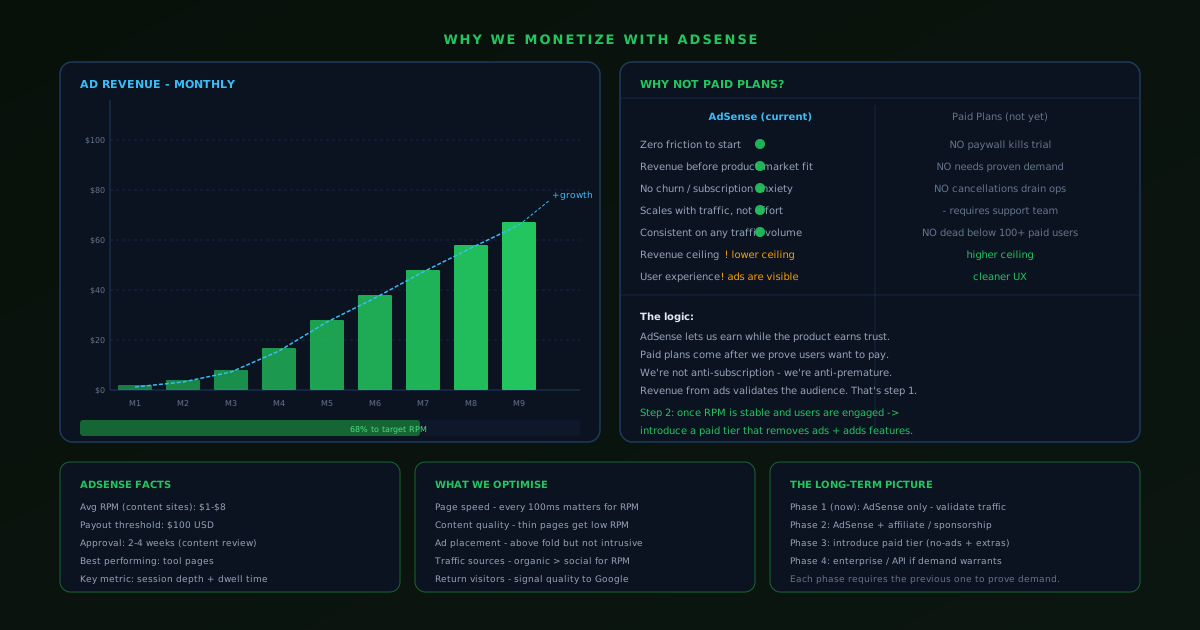
AdSense works for us at this stage because it monetizes traffic without restricting access, requires minimal ongoing management once approved, and scales proportionally with content discoverability. As the content library grows and search traffic increases, the monetization grows with it without requiring us to add subscription infrastructure or build an affiliate partnership network. The economics are modest at small traffic volumes, but the model does not require a minimum threshold of content before it starts generating any value.
The practical implementation requires maintaining content quality high enough to sustain AdSense approval — a meaningful constraint that we think makes the content better rather than worse. AdSense approval requires genuine, original, useful content without thin or duplicated pages. Those requirements align exactly with what good content marketing demands anyway. If we write field notes that are actually useful to the operators and creators who read them, the content will qualify for and sustain an AdSense relationship. That alignment between the quality bar we want to hold and the quality bar required for monetization is one of the strongest arguments for the model.
What this means for content quality and independence
Ad-based monetization does introduce one genuine tension: the incentive to maximize page views can conflict with the incentive to write the most useful thing rather than the most shareable thing. We manage this tension by keeping the content strategy anchored to topics that serve the actual Novus audience — creators, operators, and small product teams — rather than optimizing for volume keywords that would attract readers who have no relationship with the products we build.
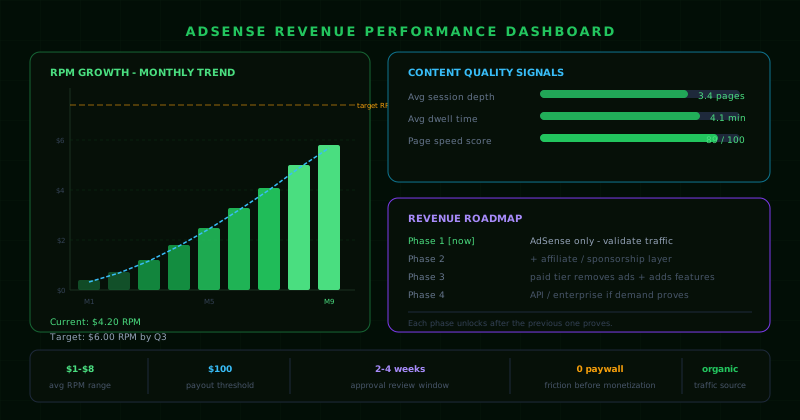
The clearest signal of whether the model is working will be whether the content continues to serve the people who find it through search and stay to read it. High time-on-page, low bounce rates on pages where readers have intent to learn, and returning visitors who build a relationship with the content over time are all signs that the ad model is not distorting the content quality. We track these signals alongside the revenue metrics so neither set of numbers can be optimized in isolation. If we ever find ourselves writing for impressions rather than for readers, that is the moment to revisit the model — and this post will be part of the record of why we chose it and what we expected from it.
Managing reader experience alongside ad revenue
Ad placement and density are reader experience decisions as much as they are revenue decisions. A page with ads that interrupt reading flow, load slowly, or displace content on mobile devices will have higher bounce rates and lower time-on-page — which reduces the signal quality of those same metrics we rely on to evaluate content performance. There is a direct operational connection between poor ad experience and degraded content analytics that makes it impossible to distinguish "readers are not interested in this content" from "readers left because the page was frustrating to use."
The practical approach is conservative ad density: fewer placements, higher relevance, and no configurations that require readers to scroll past an ad to reach content they came for. AdSense provides configuration options for placement and format that allow meaningful control over how ads appear without requiring technical intervention on every page. Use those controls to maintain reading comfort rather than maximizing fill rate. A reader who completes an article and returns for another has produced more value — in content engagement, brand trust, and eventual ecosystem affinity — than a reader who bounced from an ad-heavy page and never returned.
When we would revisit the monetization model
AdSense is the right model for this stage, not the right model forever. The conditions that would cause us to revisit it are specific: if the content library grows to a scale where a subscription product with genuine exclusivity and a dedicated audience makes sense, that is worth evaluating seriously. If the portfolio generates enough affiliated commerce relevance that carefully selected affiliate relationships become materially significant without distorting the content calendar, that could supplement or partially replace display advertising. If a product in the Novus portfolio develops a paid tier that benefits from content-to-conversion funnels, the monetization model for the content properties would naturally evolve to support that relationship.
None of those conditions are present today, which is why AdSense is the right current choice. The decision to use display advertising is not a permanent declaration about how Novus will monetize content indefinitely — it is the most appropriate decision given the current scale, the current content purpose, and the current structure of the Novus product portfolio. As those things change, the monetization approach should change with them. Documenting the reasoning now means that when the conditions change, the next decision will be made from a clear understanding of what the original choice was trying to accomplish and whether the new option serves those same goals more effectively.
Free access as a discoverability strategy
The decision to keep the content freely accessible is not just a monetization choice but a discoverability strategy, because the primary goal of the content properties is to be found, read, and trusted, and anything that restricts access works directly against that goal. A search-engine visitor who hits a paywall before reading anything has no reason to subscribe and no relationship with the content yet, so the paywall converts potential awareness into immediate friction, losing exactly the discovery the content was published to generate. Free access removes this barrier, letting the content do its primary job of bringing creators, operators, and potential partners into contact with the Novus ecosystem through genuinely useful material they can actually read.
Treating free access as a discoverability strategy reframes the monetization question entirely, because the metric that matters becomes whether the content reaches and serves its audience rather than how much revenue each reader generates. A free article that brings a new operator into the Novus orbit, builds trust, and forms an accurate picture of what the ecosystem offers is doing work that a paywalled article generating more revenue per reader could not, because the paywalled version would never have reached most of those readers. The discoverability that free access enables is the foundation that the entire content strategy rests on, since the content can only build awareness and trust if people can actually encounter it. Free access as a discoverability strategy is therefore the choice that aligns the content's accessibility with its actual purpose, accepting lower revenue per reader in exchange for the reach and trust that the content exists to build.
The economics of ads versus subscriptions at our scale
The economic comparison between ad-based and subscription monetization depends heavily on scale and content type, and at the scale and type of the Novus content properties, the ad model fits where subscriptions would not. Subscriptions work when content is exclusive, the audience has strong reasons to stay subscribed, and there is a production cadence that justifies the recurring cost — conditions that a portfolio site building content alongside products does not clearly meet. Ads, by contrast, monetize traffic without requiring exclusivity or a subscription relationship, scaling proportionally with discoverability as the content library and search traffic grow, which suits content whose value is in being widely found and read rather than in being exclusive.
The economics also differ in what each model demands of the operation. Subscriptions require building and maintaining subscription infrastructure, sustaining a production cadence that justifies the ongoing charge, and continually proving exclusivity worth paying for — significant ongoing demands that a small team building content alongside products is poorly positioned to meet. Ads require maintaining content quality high enough to sustain approval and reasonable placement discipline, but they do not require the subscription apparatus or the exclusivity treadmill. At our scale, the modest per-reader revenue of ads is the right trade for a model that does not restrict access, does not demand subscription infrastructure, and grows with discoverability rather than requiring a minimum content threshold before generating any value. The economics of ads versus subscriptions at our scale therefore favor ads not because ads are universally better but because they fit the specific reality of building useful, non-exclusive content as a small team alongside a product portfolio, which is exactly the situation the content properties are in.
Why the AdSense quality bar helps the content
A counterintuitive benefit of the AdSense model is that its quality requirements push the content to be better rather than worse, because sustaining AdSense approval requires genuine, original, useful content without thin or duplicated pages — which is exactly what good content should be anyway. The quality bar that AdSense imposes aligns precisely with the standard the content should hold for its own sake, which means the monetization requirement reinforces rather than conflicts with the content quality. Writing field notes that are actually useful to the operators and creators who read them is both what makes the content valuable and what qualifies it for and sustains the AdSense relationship, so the two goals point the same direction.
This alignment between the monetization quality bar and the content quality goal is one of the strongest arguments for the model, because it means the constraint the monetization imposes is a constraint the content would want to hold regardless. A monetization model that rewarded thin or duplicated content would create pressure toward exactly the kind of content that serves no one; the AdSense model instead requires the substance and originality that genuinely useful content already demands. The requirement to maintain content good enough to sustain AdSense is therefore not a tax on the content but a reinforcement of the standard it should meet, which is why the quality bar helps rather than hinders. Why the AdSense quality bar helps the content is the recognition that, in this case, the monetization requirement and the content mission are aligned, with the bar that sustains the revenue being the same bar that makes the content worth reading, which turns the monetization constraint into a useful discipline rather than a distorting pressure.
Keeping content independent of revenue pressure
The genuine tension in ad-based monetization is that the incentive to maximize page views can conflict with the incentive to write the most useful thing rather than the most shareable thing, and managing that tension deliberately is what keeps the content independent of revenue pressure. The risk is real: optimizing for volume keywords and shareable hooks would attract readers who have no relationship with the products Novus builds and would pull the content away from serving its actual audience. We manage this by anchoring the content strategy to topics that serve the real Novus audience — creators, operators, small product teams — rather than to whatever would maximize traffic, which keeps the content independent of the page-view pressure the ad model could otherwise impose.
Keeping content independent of revenue pressure requires actively watching for the signs that the model is distorting the content and being willing to act on them. We track engagement signals — time on page, bounce rates on pages where readers have intent to learn, returning visitors — alongside the revenue metrics, specifically so that neither set of numbers can be optimized in isolation and so that the content quality has its own measurement independent of the revenue. If we ever found ourselves writing for impressions rather than for readers, those engagement signals would reveal it, and that is the moment the model would need revisiting. Keeping content independent of revenue pressure is therefore an ongoing discipline rather than a one-time stance, requiring the deliberate choice to serve the real audience over the traffic-maximizing alternative and the measurement to catch any drift. This independence is what protects the content quality that the whole strategy — and the AdSense relationship itself — depends on, since content distorted by revenue pressure would ultimately serve neither the readers nor the monetization that requires genuine quality.
How free tools and ad-supported content reinforce each other
The free-forever tools and the ad-supported content are not separate decisions but parts of a coherent model where each reinforces the other, because both rest on the same principle of keeping access open and building trust through genuine value rather than extraction. The free tools — the in-browser background remover, the music visualizer — bring users into the Novus ecosystem by solving real problems at no cost, while the ad-supported content brings readers in by offering genuinely useful operating knowledge freely. Both lower the barrier to encountering Novus, and both build the trust that comes from delivering real value without a paywall, which is why they fit together as expressions of the same strategy rather than as unrelated monetization choices.
The reinforcement runs in both directions: the content builds awareness and trust that can lead readers to the tools, and the tools demonstrate the quality and judgment that make the content credible. A reader who finds a useful field note and then discovers that Novus also builds genuinely good free tools forms a more complete and more trusting picture of the operation than either touchpoint alone would create. The free tools and the free content together signal an operation that competes on genuine value and open access rather than on extraction, which is a coherent identity that each element strengthens. How free tools and ad-supported content reinforce each other is therefore the recognition that the monetization model and the product model express the same underlying bet — that keeping access free and building trust through real value is a sustainable foundation — which is why the AdSense decision for the content and the free-forever decision for the tools are consistent rather than coincidental, each making more sense in the context of the other.