2026 · Field notesAbout 13 min readNovus Stream Solutions
Pricing your first digital product: practical frameworks without the MBA
How to price a digital product when you have no market data yet: anchoring, willingness-to-pay signals, and the two mistakes that kill early traction.
Contents
- 1.Overview
- 2.Anchor to the alternative, not the competition
- 3.The two mistakes that kill early traction
- 4.Reading early buyer signals to validate the price
- 5.When and how to raise prices without losing your audience
- 6.Packaging and bundling as an alternative to price cutting
- 7.Communicating price clarity across all customer touchpoints
- 8.Why cost-plus is the wrong anchor
- 9.Price points and the psychology of the number
- 10.Tiering without overcomplicating
- 11.Why discounts train the behavior you do not want
- 12.Testing willingness to pay without a research budget
- 13.The confidence to charge what it is worth
- 14.Pricing is a positioning statement
Overview
First-time digital product pricing fails in one of two directions: too low because the creator undervalues their work, or too high because they are copying a competitor whose cost structure and audience trust they do not yet have.
The actual question is not "what is this worth?" but "what will someone pay to solve the problem this product solves?" Those two questions have very different answers, and only the second one is actionable before you have sales data.
Anchor to the alternative, not the competition
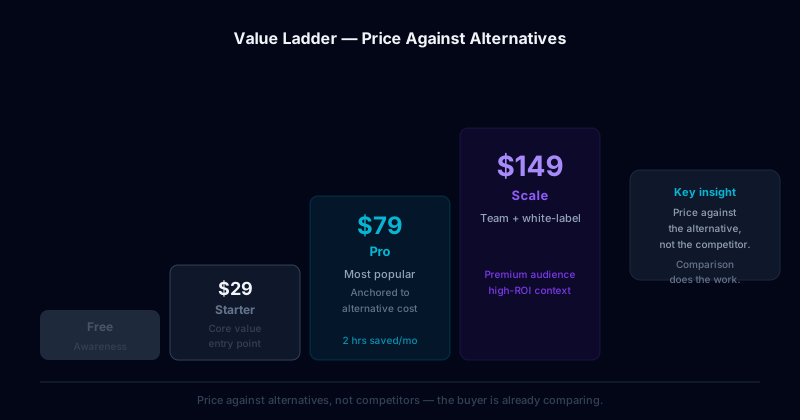
What does your buyer do today without your product? If the answer is "nothing" (there is no current solution) you have an education problem, not a pricing problem. If the answer is a more expensive tool, a consultant, or a DIY process that costs them time, anchor your price to that alternative.
A $49 digital product that saves two hours of manual work per month is not expensive if those two hours bill at $75 each. The comparison does all the work.
The two mistakes that kill early traction
Mistake one: launching at a discount to build momentum. Discounts train buyers to wait. A better early-adopter play is a smaller scope product at a lower price, not a full product at a discount.
Mistake two: not raising prices when demand exceeds supply. If your waitlist is longer than your capacity to serve, the price is too low. In digital products without hard capacity limits, a long backlog is a signal to raise prices, not to rush.
Reading early buyer signals to validate the price
Before you have enough sales data to know whether your price is right, you can read proxy signals. If every conversation with a potential buyer includes price negotiation, the price may be above the perceived value ceiling, or the value communication may be the problem rather than the number. If buyers never mention price before purchasing, you may be underpriced. The goal in early stages is to find the price where qualified buyers consider the decision without price being the first objection.
Run a simple test with your first ten customers: ask whether price was a consideration in their decision. If fewer than three mention it, you have room to raise. If more than six mention it as a significant factor, dig into whether the hesitation was about total amount or about value clarity. Those are different problems. Total-amount objections often respond to payment plan options; value-clarity objections respond to better proof and more specific outcome framing.
When and how to raise prices without losing your audience
The right time to raise prices on a digital product is when your conversion rate is stable and your support cost is known. Raising prices on a product with high support burden may not improve margins if each additional customer requires significant time. Know the unit economics before changing the price.
Announce price increases with enough lead time for existing buyers to take action if they want to lock in the current rate; two to four weeks is typical. Frame the increase around what has been added or improved since launch, not around your costs. Buyers do not care about your costs; they care about what they get. A price increase framed as "we have added X since launch and the price now reflects that" is received very differently from "prices are going up next month."
Packaging and bundling as an alternative to price cutting
When conversion is lower than expected, the instinct is to reduce the price. Often the better move is to change what the price buys. Bundling a digital product with a template, a recorded workshop, or priority support access can increase the perceived value enough to remove the purchase hesitation without reducing the unit price. This matters because once you establish a lower price as the reference, it is hard to raise it back without friction. Adding scope to maintain a price is a reversible strategy; cutting price sets a new floor that is hard to raise.
Design bundles around the specific use case of the buyer who is hesitating, not around what you have available to add. If buyers are hesitating because they are uncertain whether they can implement the product, a "done with you" session is more relevant than an additional template. If they are hesitating because they are comparing you to a cheaper competitor, a clear feature comparison and a results guarantee may be more persuasive than adding more content they may never use. Understand the hesitation before designing the bundle.
Communicating price clarity across all customer touchpoints
Price confusion is a conversion killer that is easy to create and hard to notice from the inside. When the price on the product page, the checkout page, and the welcome email all display slightly different information (different currency, different billing period, different inclusions) buyers lose confidence and abandon. Audit every touchpoint where price appears and confirm they present consistent information in the same format. This is a fifteen-minute audit that removes a category of friction from every purchase.
Clarity also means being transparent about what is not included. If your base price does not include a feature that competitors include by default, note that clearly rather than burying it in feature comparison tables. Buyers who discover an omission at checkout feel misled even if the information was technically available. The cost of a clear "base plan does not include X" disclaimer is much lower than the cost of a refund request or a negative review from a buyer who felt surprised.
Why cost-plus is the wrong anchor
A tempting way to price a first product is cost-plus: add up what it cost you to make, add a margin, and call that the price. For digital products especially, this is almost always wrong, because the cost to produce a digital product bears no relationship to the value it delivers. A product that took a weekend to build might save its buyers dozens of hours, and a product that took months might solve a problem worth very little; pricing either by its production cost ignores the only thing the buyer actually cares about, which is what the product does for them. Cost-plus anchors the price to your effort rather than to the buyer's benefit, which is the wrong end of the transaction.
The deeper problem with cost-plus is that it caps your price at a number disconnected from value, often far below what the product is worth to the buyer. If your product saves a buyer a large amount of time or money, its value to them may be many times its cost to you, and cost-plus pricing leaves all of that value on the table. The correct anchor is the value delivered or the cost of the alternative the buyer would otherwise use, not your production cost. Cost-plus feels safe and rational because the inputs are knowable, but it systematically misprices products whose value diverges from their cost, which is to say, most digital products. Pricing to value rather than to cost is the shift from charging for your effort to charging for the buyer's outcome.
Price points and the psychology of the number
The specific number you choose carries psychological weight beyond its arithmetic, and small differences in the price point can shift how buyers categorize the purchase. A price sits in a mental category (trivial, considered, significant) and the boundaries between those categories matter more than the exact figure. The difference between a price that reads as an easy yes and one that triggers deliberation is often a matter of which category the number falls into for your specific buyer, which depends on the context they are comparing against. Understanding which category you want the purchase to occupy helps you choose a number that lands there rather than just picking a figure that feels right.
This is also why the framing around the number matters as much as the number itself. The same price feels different depending on what it is compared to, what it is bundled with, and how it is presented: monthly versus annual, standalone versus anchored against a more expensive alternative. The psychology is not manipulation; it is recognizing that buyers do not evaluate prices in a vacuum but relative to references, and choosing the references and the presentation that let the buyer see the value clearly. A well-chosen price point, framed against the right alternative, lets a fair price feel fair, while the same price presented without context can feel arbitrary or high. The number and its framing are a single decision, and attending to both is part of pricing deliberately rather than by guess.
Tiering without overcomplicating
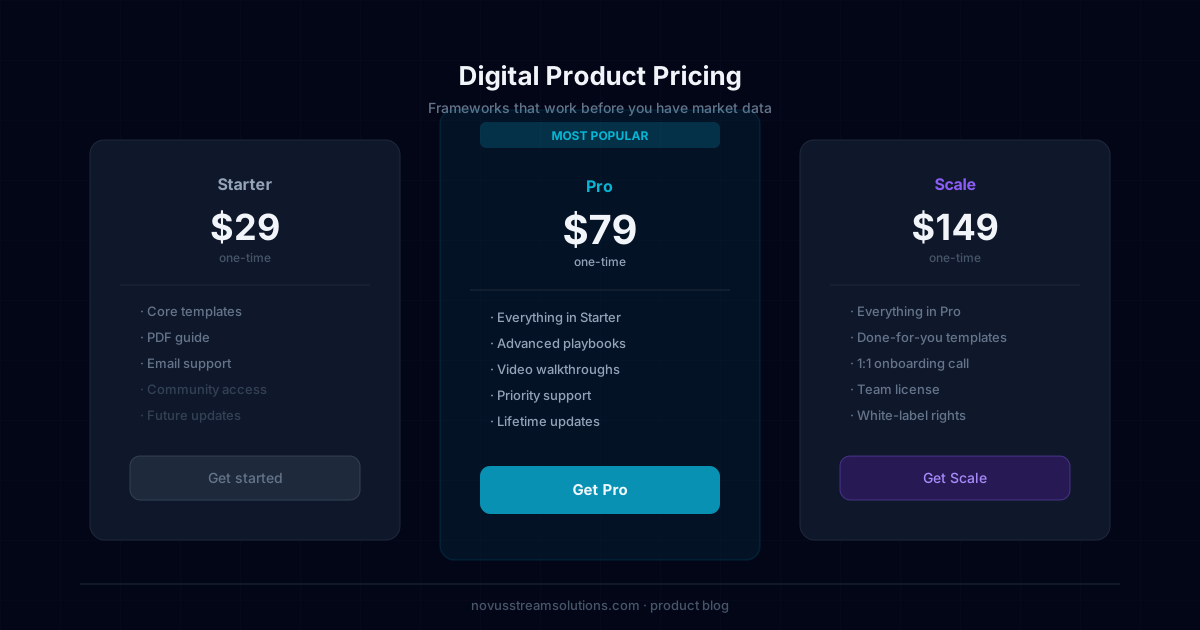
Tiered pricing (offering a few versions at different price points) can serve buyers with different needs and capture more value, but it is easy to overcomplicate into a confusing matrix that paralyzes rather than helps. The principle of good tiering is that each tier should correspond to a clearly different kind of buyer with a clearly different need, not just more of the same thing at a higher price. Two or three well-differentiated tiers, where a buyer can quickly self-identify which one fits them, serve far better than five tiers whose differences require a comparison table to parse. The goal of tiers is to make the choice easier by matching options to buyer types, not harder by multiplying options.
The most common tiering mistake is too many tiers or tiers that differ in ways buyers do not care about, which turns a simple purchase decision into a research project. When faced with too many similar options, buyers often choose none, because the effort of deciding exceeds the value of optimizing. A clean tier structure (perhaps a focused entry option, a complete standard option, and a higher option for the buyer with bigger needs) lets most buyers find their fit in seconds. If you cannot explain in a sentence why a buyer would choose each tier, you have too many or they are differentiated on the wrong dimensions. Tiering should reduce decision friction by sorting buyers, not increase it by presenting a puzzle.
Why discounts train the behavior you do not want
Discounting feels like a low-risk way to drive sales, but it trains buyers in ways that undermine your pricing over time. A buyer who purchases at a discount learns that your real price is the discounted one and that waiting for a sale is rewarded, which means your full price becomes a number few people pay and your discounts become an expectation rather than a promotion. The short-term sales bump from a discount comes at the long-term cost of conditioning your audience to devalue your product and to delay purchases in anticipation of the next discount. The behavior you reinforce is exactly the behavior that erodes your pricing power.
The better tools for driving early sales preserve the price while changing what is offered. A smaller-scope product at a genuinely lower price, a time-limited bonus that adds value rather than cutting price, or early-adopter access framed as a privilege rather than a discount all create urgency or value without teaching buyers that your price is negotiable. The distinction is between lowering the price, which sets a new reference that is hard to raise, and adding value or limiting scope, which leaves the price intact. Protecting the integrity of your price is a long-term asset, and reflexive discounting spends that asset for a short-term gain. The discipline is to find ways to motivate purchase that do not train your audience to wait for the price to drop.
Testing willingness to pay without a research budget
You do not need market research to learn whether your price is roughly right; the early sales conversations themselves are the test, if you pay attention to the right signals. The pattern of how buyers respond to your price tells you a great deal: if price is the first objection in most conversations, you may be above the perceived-value ceiling or have a value-communication problem; if buyers never mention price, you may have room to charge more. The goal in the early stage is to find the price at which qualified buyers engage with the decision on its merits, with price as a consideration but not the primary obstacle. The conversations are free research if you listen for the signal.
A simple, concrete test with your first handful of customers is to ask directly whether price factored into their decision, and to listen for whether hesitation is about the total amount or about value clarity, because those are different problems with different fixes. Total-amount hesitation often responds to payment options or a smaller-scope entry point; value-clarity hesitation responds to better proof and more specific outcome framing. This kind of lightweight, qualitative testing with real buyers gives you actionable signal long before you have enough sales data for statistical confidence, and it costs nothing but the willingness to ask and to hear the answer honestly. Early buyers will tell you whether your price is right if you create the small opening for them to do so.
The confidence to charge what it is worth
A surprising amount of first-product mispricing is not analytical but psychological: the creator undervalues their own work and sets a price below what buyers would happily pay, out of a discomfort with charging. This underpricing is well-intentioned (it feels generous, or safe, or humble) but it does the buyer no favors and does the business real harm. An underpriced product signals lower value, attracts buyers who are shopping on price rather than fit, and starves the business of the revenue it needs to keep improving the product. The discomfort with charging is understandable but is a problem to be worked through rather than accommodated, because the price that feels comfortable to the underconfident creator is often well below the price that is actually fair.
Building the confidence to charge appropriately comes from anchoring on the value delivered rather than on your feelings about your own work. When you frame the price against what the product saves or earns the buyer, or against the cost of the alternative, a fair price stops feeling presumptuous and starts feeling justified, because it is. The buyer who pays a fair price for a product that genuinely helps them has made a good trade, and underpricing denies them the clear signal of value that an appropriate price provides while denying you the revenue to serve them well. Charging what the work is worth is not greed; it is the honest recognition of the value exchanged, and developing the confidence to do it is part of pricing maturely rather than apologetically.
Pricing is a positioning statement
Finally, it is worth recognizing that a price is not only a number but a positioning statement that tells buyers what kind of product yours is and what kind of buyer it is for. A price communicates a category: a very low price signals a commodity or an entry-level option, a premium price signals a high-value or specialized offering, and the number you choose places your product in the buyer's mental hierarchy before they have evaluated a single feature. This means pricing cannot be separated from positioning: the price has to be consistent with the story you are telling about the product, because a mismatch between the two creates confusion that undermines both.
This positioning function is why copying a competitor's price can be a mistake even when the products are similar: the price has to fit your positioning, your audience's trust in you, and the story you are telling, which may differ from the competitor's even for a comparable product. A price that is right for an established brand with deep trust may be wrong for a new entrant who has not yet earned that trust, and vice versa. Choosing a price is therefore choosing a position, and the price should be set in coordination with how you want the product perceived rather than in isolation as a pure number. Pricing as positioning means the number is part of the product's identity, and setting it well requires thinking about what it says, not just what it earns.
Frequently asked questions
Quick answers to common questions about this topic.
How do I price my first digital product?
Price on the value it delivers, not the time it took to make. Look at what alternatives cost, anchor with a clear reference point, and start a bit higher than feels comfortable; you can discount more easily than raise.
Should a first product have multiple price tiers?
A simple good/better tier can lift revenue by letting buyers self-select, but do not over-engineer it early. One clear price you can explain beats a confusing menu.
Related troubleshooting
Was this page helpful?
Your answer stays in this browser, it is not sent anywhere and no account or cookie is involved.