2026 · Novus Stream Solutions (hub)About 16 min readNovus Stream Solutions
Hiring your first contractor or VA without losing quality
Most solo operators botch their first hire by handing off something they never actually solved. The fix is unglamorous: delegate the recurring, rules-based, already-documented work first, prove fit with a small paid trial, and onboard with real access hygiene. This is how you add hours without losing the quality that got you here.
Contents
- 1.Overview
- 2.Why the first delegation usually fails
- 3.The delegation matrix: what to give away first
- 4.Concrete tasks that belong in the first-hire quadrant
- 5.Writing the task so someone else can run it
- 6.Contractor versus employee, at a high level
- 7.Finding people and screening them
- 8.Why a small paid trial beats interviews and portfolios
- 9.Onboarding with access hygiene from day one
- 10.Reviewing output without micromanaging
- 11.Start with a few hours a week, not a full-time leap
- 12.When NOT to hire yet
Overview
There is a specific moment when a one-person business stops scaling: the day you are the bottleneck for everything and you finally decide to bring in help. It feels like a milestone, and it is, but it is also where a surprising number of solo operators quietly lose ground. They hire someone, hand over a pile of work, watch the quality slip, spend more time fixing than they ever spent doing, and conclude that nobody can do it as well as they can. Then they take it all back and stay stuck. The failure is real, but the diagnosis is almost always wrong. The problem is rarely the person you hired. The problem is what you chose to hand over and how you handed it over.
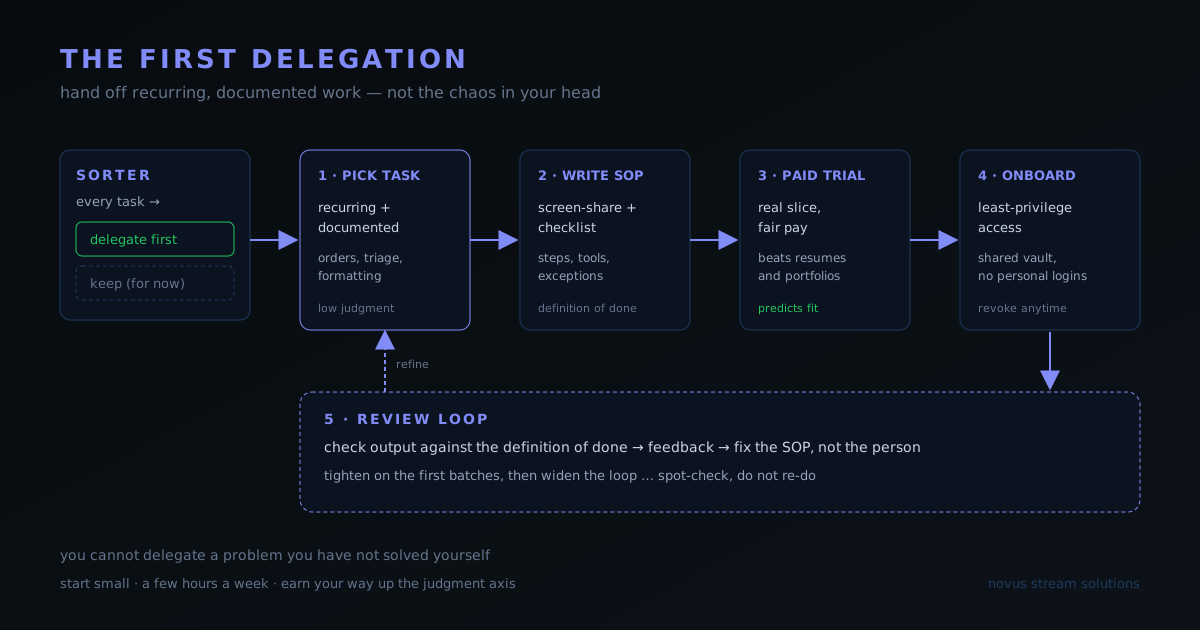
The uncomfortable truth underneath the first hire is this: you cannot delegate a problem you have not solved yourself. If a task lives only in your head, shaped differently every time you touch it, then handing it to a contractor or virtual assistant does not remove the chaos. It just relocates it, and now there is a second person involved and a payment going out the door. This post is about doing the first delegation in the order that actually works. We will sort what to give away first, write a task so someone else can run it, find and screen a person, prove fit with a small paid trial instead of a resume, onboard with access hygiene that protects the business, and review output without hovering. Throughout, the bias is toward small, reversible steps.
Why the first delegation usually fails
Watch a typical first hire and the pattern repeats. The owner is drowning, so they reach for the most painful thing on their plate and try to give it away. But the most painful thing is usually painful precisely because it is messy, judgment-heavy, and undocumented. It is the work that bends to context, that you do by feel, that you would struggle to explain even to a friend over coffee. You hand it over with a few rushed sentences and a hopeful tone, the new person does their honest best, and the result is wrong in ten small ways you never thought to specify. You feel vindicated in your suspicion that good help is impossible to find, and the contractor feels set up to fail, because they were.
The deeper issue is that delegation is a documentation problem before it is a hiring problem. When something is ad-hoc in your own head, the act of writing it down forces you to make a hundred tiny decisions explicit: which orders get the expedited label, what tone the refund email takes, where the product photos live, when an exception is escalated to you. If you have not made those decisions, no hire can read your mind. So the real first step is not posting a job. It is choosing work that is already stable enough to describe, and being honest about which of your tasks meet that bar. Most operators discover they have fewer truly delegable tasks than they thought, and that realization is the actual beginning of getting help.
The delegation matrix: what to give away first
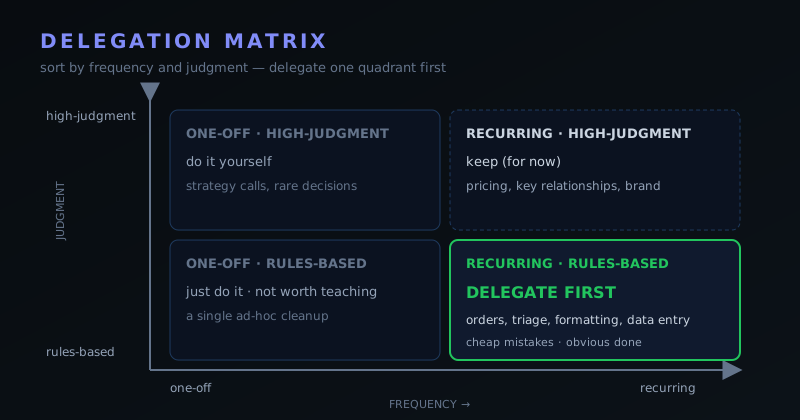
A simple sorting tool keeps you from handing over the wrong thing. Picture a two-by-two grid. One axis is frequency, running from one-off tasks on the left to recurring tasks on the right. The other axis is judgment, running from rules-based work at the bottom to high-judgment work at the top. Every task you do falls into one of the four quadrants, and the order in which you delegate them matters enormously. The quadrant you want first is the bottom-right: recurring and rules-based. This is the work that happens over and over, follows clear rules, and rarely requires you to weigh competing priorities or make a call only you can make. It is the least glamorous work you do, and it is exactly where a first hire creates the most leverage with the least risk.
The other quadrants wait their turn or stay with you. One-off rules-based tasks are not worth the overhead of teaching someone for a job that will not repeat. High-judgment recurring work, like pricing decisions, key client relationships, or anything that defines your brand, is the quadrant to keep for now, even though it is tempting to offload because it is heavy. And one-off high-judgment work is almost always yours alone. The mistake nearly everyone makes on the first hire is reaching for the top, the judgment work, because that is what exhausts them. Resist it. Build the muscle of delegating on the easy quadrant first, where mistakes are cheap and the definition of done is obvious, and earn your way upward as trust and documentation grow.
Concrete tasks that belong in the first-hire quadrant
It helps to leave the abstract grid and name the actual work. In a small online shop, the recurring rules-based quadrant is fuller than you expect. Order processing is the classic example: pulling new orders, checking stock, generating shipping labels, and updating the tracking number once it ships. Inbox triage by rules is another: a contractor can sort incoming mail into buckets, send the three or four standard replies you have already written, and flag only the genuine exceptions for you. Listing formatting fits too, where you have set the template and someone fills it in consistently across products. Data entry, light bookkeeping categorization against rules you define, and basic support macros all live here. None of these require taste. They require care, consistency, and a clear set of rules to follow.
Notice what is not on that list. Your core craft is not there, whether that is the design, the writing, the product development, or the customer conversations that win loyalty. The relationships that hold the business together are not there. The decisions that shape your brand are not there. The first hire is not about cloning yourself; it is about reclaiming the hours that consume you without using your particular skill. When you protect your craft and offload the mechanical, you do not lose quality where it matters, and you free up the attention to actually run the place. Here is a quick reference for the kinds of work that tend to sort cleanly into the first-hire quadrant.
- Order processing: pulling orders, checking stock, generating labels, posting tracking numbers.
- Inbox triage by rules: sorting mail, sending pre-written standard replies, flagging real exceptions.
- Listing and content formatting against a fixed template you already designed.
- Data entry and rules-based categorization where the criteria are written down.
- Basic support macros and FAQ responses for common, low-stakes questions.
- Scheduling and calendar coordination with clear constraints on what is acceptable.
Writing the task so someone else can run it
Once you have picked a task from the right quadrant, you have to turn it into something transferable, and that is the standard operating procedure, or SOP. An SOP is not a vague description; it is a recipe specific enough that a competent stranger could follow it and produce the result you would. The most efficient way to build one is to record yourself doing the task once, narrating every decision out loud, including the small judgment calls you barely notice anymore. Then pair that screen-share recording with a written checklist of the discrete steps, the tools and logins involved, the rules for the common exceptions, and a plain statement of what finished looks like. The video shows the texture; the checklist gives them something to tick through every time without rewatching.
This is genuinely hard the first time, because writing the SOP exposes every place you were running on instinct. That is a feature, not a bug. The act of documenting often improves the process itself, surfacing steps that were redundant or rules that contradicted each other. If you cannot write the SOP, that is your signal that the task is not ready to delegate, no matter how badly you want it off your plate. We have a full walkthrough of this in our piece on SOPs for a tiny team, and it is worth reading before you write your first one. The short version: the SOP is the thing you are actually hiring against. The person is just someone capable of following it well.
Contractor versus employee, at a high level
Before money changes hands, understand that how you classify the person matters. A contractor, freelancer, or virtual assistant is generally an independent business that controls how they do the work, often serves multiple clients, uses their own tools, and is paid per task or per hour against an invoice. An employee is typically someone whose work you direct in detail, who works set hours under your control, and for whom you carry payroll, tax withholding, and various obligations. The line between the two is not yours to declare by writing contractor on an agreement; tax authorities and labor regulators look at the actual working relationship. Misclassifying an employee as a contractor to save on obligations is a real risk that can come back on you.
For a first hire, most small operators genuinely want a contractor relationship: a defined scope, an invoice, independence in execution, and no payroll machinery. That keeps things simple and reversible while you learn how to delegate at all. But the right answer depends on your jurisdiction and on how the work is structured, and the rules differ meaningfully between countries and even regions within them. This is general education, not legal advice, so check your local rules or talk to an accountant before you commit to a structure. The practical takeaway is to be deliberate about it up front rather than discovering the distinction later, because retrofitting a relationship after the fact is far more painful than setting it up correctly from the start.
Finding people and screening them
With a documented task in hand, finding a person becomes much less daunting, because you are no longer searching for a mind reader. You are searching for someone reliable who can follow a clear process. The best source is almost always a referral from another operator you trust, because a working relationship that someone will vouch for tells you more than any profile. When you do not have a warm introduction, marketplaces like Upwork let you post a tightly scoped task and review proposals, though the signal there is noisy and you should expect to filter heavily. Either way, write the posting around the actual SOP. Describe the recurring task, the tools, the hours per week, and the standard you hold, and you will attract people who want exactly that kind of steady work rather than a vague catch-all assistant role.
Screening, at this stage, should stay light and practical. Read enough to confirm they have done similar rules-based work, that they communicate clearly in writing, and that their availability and timezone fit your rhythm. Do not over-index on polished portfolios or fluent interviews, because both measure presentation more than they measure the boring reliability the job needs. A great interviewer can still miss steps on a checklist, and a quiet candidate can be flawless at exactly the kind of consistent execution you are hiring for. The goal of screening is only to narrow the field to a few plausible people. The real test, the one that actually predicts performance, comes next, and it does not happen on a call.
Why a small paid trial beats interviews and portfolios
The single highest-leverage move in a first hire is to skip straight to a small, paid trial task. Interviews tell you how someone presents. Portfolios tell you what their best past work looked like, possibly with help you cannot see. Neither tells you what you actually need to know: can this specific person follow your specific SOP and produce your standard, consistently, on the work you are paying for. A paid trial answers that directly. You take a real slice of the recurring task, hand them the SOP, and pay them fairly for a few hours of genuine work. You are not asking for free labor, which is both unfair and a poor signal; you are buying a high-resolution preview of the actual working relationship before you commit to it.
What you learn from a trial goes well beyond whether the output was correct. You see how they handle ambiguity when the SOP does not cover a case, whether they ask a good question or guess silently, how they communicate when something is unclear, and whether they hit the timeline they agreed to. You also learn about yourself: whether your SOP was as clear as you thought, and where it needs another sentence. Run the same small trial with two or three candidates and the differences are usually obvious and decisive. The cost is modest, the information is excellent, and the whole thing is reversible. If a trial goes poorly, you have lost a few hours of pay and gained clarity, which is a far better outcome than discovering the mismatch three months into a standing arrangement.
Onboarding with access hygiene from day one
When you decide to proceed, the very first practical step is access, and this is where careless operators create problems that outlast the hire. Do not hand over your personal logins. Do not email a password. Do not give someone the keys to everything because granting narrow access felt like too much friction in the moment. Instead, use a password manager with shared vaults so you can grant access to specific accounts without ever exposing the underlying credentials, and so you can revoke that access instantly the day the relationship ends. Give the least privilege the task requires and nothing more: a contractor processing orders needs the order system, not your bank, your domain registrar, or your email administration.
This is not paranoia; it is ordinary business hygiene, and it doubles as continuity protection. The same discipline that keeps a contractor scoped to what they need also means no single person, including you, is an irreplaceable point of failure with secrets nobody else can reach. We treat this as part of a broader continuity plan, the bus-factor problem of a one-person business, and the access setup you build for your first hire is a natural first piece of it. Set it up before the work starts, not after, because retrofitting access discipline onto a live working relationship is awkward and usually gets skipped. A clean start here costs you twenty minutes and saves you from the messy, anxious scramble that follows when access was never controlled in the first place.
Reviewing output without micromanaging
Delegation does not end at handoff; it lives or dies in the review loop. The anchor of a good loop is a clear definition of done, written into the SOP, so that quality is a checkable standard rather than a feeling in your gut. When done is defined, review becomes fast and unemotional: you check the output against the standard, and either it meets the bar or it does not. That is very different from the vague unease of looking at someone else's work and sensing it is not quite how you would have done it. Much of what feels like a quality problem in a first hire is actually an undefined-standard problem, and the fix is on your side of the table, not theirs.
Give feedback early, specifically, and against the written standard rather than against your taste, and route it through the SOP so the same correction does not recur. If the same mistake keeps happening, the SOP is probably missing a rule, so fix the document instead of repeating yourself. Resist the pull to hover over every action, because micromanagement defeats the entire purpose: you wanted hours back, and watching every keystroke gives none of them back while signaling that you do not trust the person to follow a process you built. Start with closer review on the first batches, then widen the loop as the work proves consistent. The destination is a rhythm where you spot-check rather than re-do, and where your attention returns to the work only you can do.
Start with a few hours a week, not a full-time leap
Scale the commitment to match what you have actually proven. A first hire should usually start at a few hours a week, on a single well-documented task, not at a full-time arrangement covering a sprawling list of responsibilities. Small is not timidity; it is good risk management. A few hours a week lets both sides learn the working relationship cheaply, lets you refine the SOP against real output, and keeps the financial commitment low while you build the trust that justifies expanding it. If the first task goes well, you add the next task from the right quadrant, then perhaps more hours, growing the relationship in steps that each prove out before the next one begins.
This staged approach also protects your cash flow, which for a small operator is often the real constraint. Committing to a large fixed cost before you have proven the leverage is how a hopeful hire becomes a financial weight you resent. A few reliable hours a week that genuinely free your time is a far better foundation than a full-time role you scrambled to fill and now have to keep busy. The compounding benefit is quiet but real: each delegated task that runs smoothly without you returns a slice of attention you can spend on the high-judgment work that actually grows the business, which is the entire point of getting help in the first place.
When NOT to hire yet
Sometimes the honest answer is not yet, and recognizing that saves real money and grief. Do not hire if you have no documented process. If the task lives only in your head and you have not written the SOP, you are not ready, because you will hand over chaos and blame the person for the mess that was already there. Do not hire if you do not have steady cash to pay reliably. A contractor relationship depends on dependable, on-time payment, and stretching to afford help you cannot consistently fund damages your reputation as a client and puts you in a worse spot than before. The discipline of paying reliably is part of the deal, and if the money is not there yet, fix that first.
The subtlest trap is trying to outsource a decision rather than a task. If what actually exhausts you is the weight of a choice, like how to price, which direction to take the brand, or whether to fire a difficult customer, no contractor can carry that for you, and handing them the symptoms of an unmade decision just produces confused work and frustration on both sides. Make the decision, encode it into rules, and then delegate the execution of those rules. That sequence matters. Delegation is for tasks that follow rules you have set, not for the judgment that sets the rules. When you respect that line, your first hire adds capacity. When you cross it, you have simply paid someone to share your confusion.
Frequently asked questions
Quick answers to common questions about this topic.
What should I delegate first as a solo operator?
Start with the recurring, rules-based, already-documented quadrant of your work: order processing, inbox triage by clear rules, listing or content formatting against a template, data entry, and basic support macros. These tasks happen often, follow clear rules, and rarely need a judgment call only you can make, so a first hire creates leverage there with low risk. Keep your core craft and high-judgment recurring work, like pricing and key relationships, for yourself for now.
Should my first hire be a contractor or an employee?
Most first hires for a small online business fit a contractor relationship: a defined scope, independence in how the work gets done, payment by invoice, and no payroll machinery. An employee is someone whose work you direct in detail and for whom you carry payroll and tax obligations. The classification depends on the actual working relationship, not just what the agreement says, and the rules vary by jurisdiction. This is general education, not legal advice, so check your local rules or ask an accountant before you commit.
Why is a paid trial task better than an interview or portfolio?
Interviews measure how someone presents and portfolios show curated past work, possibly with help you cannot see. Neither tells you whether this specific person can follow your specific process and hit your standard consistently. A small paid trial does exactly that: you hand them a real slice of the task and the SOP, pay fairly for a few hours, and watch how they handle the work, ambiguity, and deadlines. It is reversible, cheap, and far more predictive than any conversation.
How do I write a task so someone else can do it well?
Build a standard operating procedure. Record yourself doing the task once while narrating every decision, then pair that screen-share with a written checklist of the steps, the tools and logins, the rules for common exceptions, and a plain definition of done. The video shows the texture and the checklist makes it repeatable. If you cannot write the SOP, the task is not ready to delegate yet, which is useful information in itself.
How do I give a contractor access without risking my accounts?
Never share personal logins or email a password. Use a password manager with shared vaults so you can grant access to specific accounts without exposing the underlying credentials, and revoke it instantly when the relationship ends. Grant the least privilege the task requires and nothing more, so someone processing orders never touches your bank, domain registrar, or email administration. Set this up before the work starts, because it is also basic business-continuity hygiene.
When should I wait and not hire anyone yet?
Hold off if you have no documented process, since handing over an undocumented task just transfers the chaos. Hold off if you do not have steady cash to pay reliably, because dependable payment is part of the deal and stretching for it damages the relationship. And hold off if you are really trying to outsource a decision rather than a task; no contractor can make a pricing or brand call for you. Make the decision, encode it into rules, then delegate the execution of those rules.
Related troubleshooting
Was this page helpful?
Your answer stays in this browser, it is not sent anywhere and no account or cookie is involved.