2026 · Field notesAbout 13 min readNovus Stream Solutions
Responding to negative feedback publicly: a small-team playbook
How small teams handle public criticism without spiraling: a decision framework for when to respond, what to say, and how to close the loop without making it worse.
Contents
- 1.Overview
- 2.The three-category framework
- 3.Closing the loop
- 4.What you should never do in a public response
- 5.Using negative feedback to improve operations
- 6.Training your team for consistent public responses
- 7.Building a response template library that stays current
- 8.The observer is the real audience
- 9.Move resolution to a private channel
- 10.When silence is the correct response
- 11.Distinguish patterns from incidents
- 12.The apology that actually works
- 13.Protecting the team from the spiral
- 14.Feedback is an operational input, not just a threat
Overview
Public negative feedback has two audiences: the person who left it, and everyone else who sees your response. Most teams optimize for the first and ignore the second, which is why their responses often make things worse rather than better.
A good public response is not primarily about resolving the specific complaint; it is about demonstrating to observers how you operate under pressure. Observers use that signal to decide whether you are the kind of business they want to trust with their money and attention.
The three-category framework
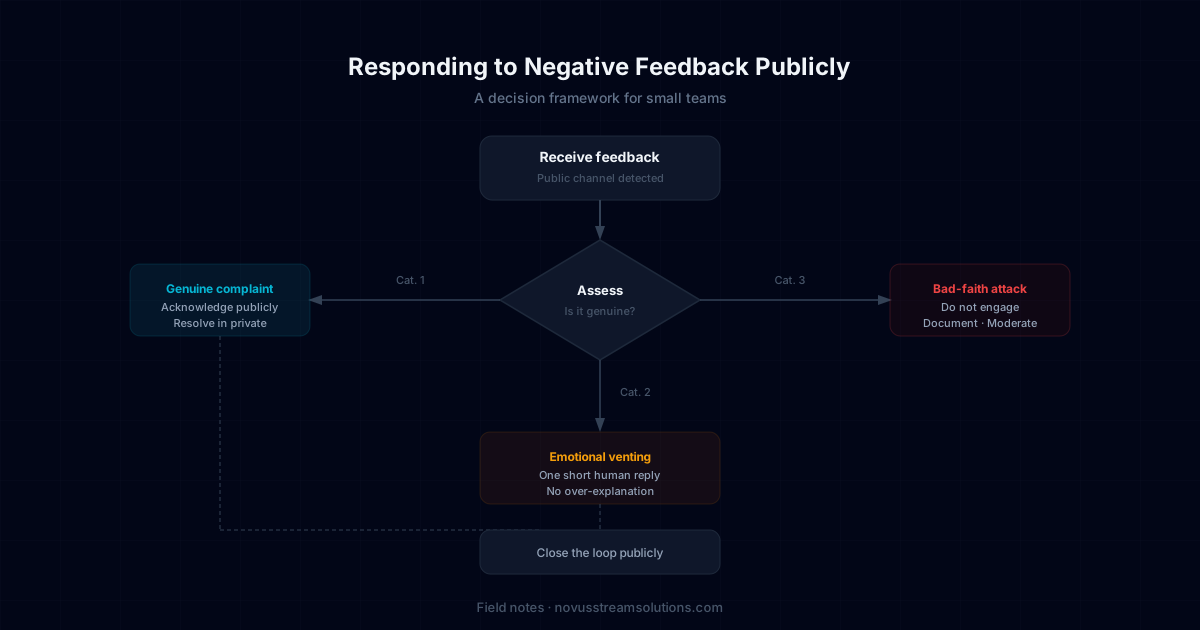
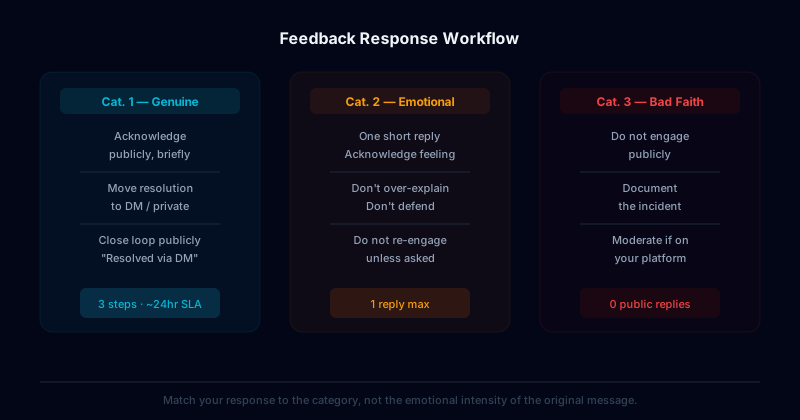
Category one is genuine feedback with a legitimate complaint. Respond publicly with a brief acknowledgment, then move resolution to a private channel. Never argue specifics publicly; you will not win, and the argument is not the point.
Category two is emotional venting without a specific ask. Acknowledge the frustration without accepting responsibility for things outside your control. One short, human response. Do not over-explain.
Category three is bad-faith attacks or coordinated harassment. Do not engage publicly. Document, moderate if on your own platform, and move on. Engagement with bad-faith actors rarely improves the situation and often escalates it.
Closing the loop
After a complaint is resolved, go back to the original public thread and close it, not to declare victory but to let anyone who saw the complaint also see the resolution. "Update: this has been resolved via DM" is enough. It signals that you follow through.
Track repeated complaint patterns separately from individual incidents. One complaint about shipping speed is a data point. Five complaints about the same SKU in a month is a fulfillment signal. Your response playbook handles the individual; your operations review handles the pattern.
What you should never do in a public response
Do not argue about facts in public, even when you are right. Public fact-checking of a customer complaint rarely results in the other person backing down, and it often generates sympathy from observers for the person who appears to be fighting a business. The goal of a public response is not to win; it is to demonstrate composure and operational competence to everyone watching. Save the detailed factual correction for a private conversation where it can actually change someone's understanding.
Do not write responses in the heat of the moment. If a negative post angers you, write the response and then wait 30 minutes before publishing it. Emotional responses read as defensive even when they are technically accurate. A calm, brief acknowledgment written an hour later will almost always serve you better than an immediate, comprehensive rebuttal. The delay also gives you time to verify any facts you plan to reference, which prevents the secondary problem of a publicly incorrect correction.
Using negative feedback to improve operations
Every negative feedback event is a diagnostic opportunity. The complaint tells you something about the gap between customer expectation and your delivery, whether that gap is in the product, the communication, the fulfillment process, or the support experience. Teams that treat feedback as primarily a reputation management problem miss most of the operational signal it carries.
Build a lightweight feedback log that captures the category, frequency, and resolution path for each complaint type. Review it quarterly alongside your other operational metrics. This creates a different kind of accountability than standard metrics: it shows you where your processes are consistently producing disappointed customers rather than just where your numbers are trending. The goal is not to eliminate all negative feedback, which is impossible, but to stop generating the same complaint repeatedly because no one connected it to an operational fix.
Training your team for consistent public responses
Inconsistent public responses are a brand risk. When one team member acknowledges a complaint warmly and another responds with a defensive FAQ link to the same category of complaint, the inconsistency signals internal disagreement about values, and observers read it that way. Small teams that have not written a response framework often discover inconsistency not during calm periods but when complaint volume spikes and everyone is responding quickly from their own instincts.
A response framework does not need to be long. A half-page document with the three complaint categories, the approved language for each, and a list of things that should never appear in a public response covers most cases. The goal is shared vocabulary and shared judgment, not a script. When a team member faces an edge case, the framework should help them reason to the right answer rather than tell them exactly what to say in every situation; the latter is impossible to write comprehensively and produces robotic-sounding responses.
Building a response template library that stays current
Templates accelerate response without sacrificing quality, but only if they stay current. A template written for a product that has changed significantly will produce responses that are accurate to an older version of your business. Assign ownership of the template library to one person and build a quarterly review of each template into their responsibilities. Each review asks two questions: does this template still reflect how we want to be perceived, and does it still accurately describe the product, policy, or process it references?
Good templates are starting points, not fill-in-the-blank forms. The best public responses acknowledge the specific situation with enough personalization that the original commenter and observers can tell the response was written for their complaint rather than copy-pasted from a queue. A template that enables 80% of the response to be pre-written while leaving a specific acknowledgment slot open balances efficiency with the authenticity that makes public responses actually improve trust rather than just close the thread.
The observer is the real audience
The single most important reframe for handling public negative feedback is that the person who left it is not your primary audience; the silent observers who see your response are. For every person who posts a public complaint, many more read it and watch how you respond, and they use that response to form a judgment about whether you are the kind of operation they want to trust. This means the goal of a public response is not primarily to satisfy the complainant, who may be unsatisfiable, but to demonstrate to the observers how you behave under pressure. Optimizing for the observer rather than the complainant changes everything about how you respond.
This reframe resolves a lot of the difficulty in public responses. When you optimize for the complainant, you get drawn into arguing specifics, defending facts, and trying to win, none of which works and all of which looks bad to observers. When you optimize for the observer, you focus on demonstrating composure, fairness, and operational competence, which is what actually builds trust with the audience that matters. A complaint you cannot resolve to the complainant's satisfaction can still be a net positive if your response shows observers that you handle problems well. Remembering that the real audience is watching silently, and that they are judging your character rather than the merits of the specific dispute, is what keeps a public response strategic rather than defensive.
Move resolution to a private channel
A reliable structure for handling a legitimate public complaint is to acknowledge briefly in public and move the actual resolution to a private channel. The public acknowledgment serves the observers (it shows you saw the complaint and are taking it seriously) while the private resolution is where the substance happens, away from the performance pressure and the temptation to argue specifics in front of an audience. This separation works because the public and private contexts have different purposes: public is for demonstrating responsiveness, private is for solving the problem, and conflating them leads to either an unresolved complaint or a messy public negotiation.
The private channel also changes the dynamics of the resolution itself. Away from the public stage, the complainant is often more reasonable, because they are no longer performing for an audience either, and the conversation can focus on the actual issue rather than on saving face. A problem that looked intractable in public frequently resolves cleanly in private once both parties are out of the spotlight. The discipline is to resist the urge to resolve everything in the public thread (which feels transparent but usually goes badly) and instead to acknowledge publicly and solve privately. This structure protects both the resolution, which goes better in private, and the public impression, which is served by a brief, composed acknowledgment rather than a drawn-out public back-and-forth.
When silence is the correct response
Not every public complaint deserves a response, and recognizing when silence is correct is an important part of the playbook, because responding to bad-faith attacks or coordinated harassment usually escalates rather than resolves. When the feedback is not a genuine complaint but an attack designed to provoke, engagement is what the attacker wants, and providing it amplifies the attack and draws more attention to it. The right response to bad-faith content is to document it, moderate it if it is on a platform you control, and otherwise decline to engage, because engagement feeds the dynamic while silence starves it.
The skill is in distinguishing the bad-faith attack from the genuine-but-angry complaint, because they can look similar in their intensity. A genuine complaint, even an emotional one, has a real grievance underneath and an observer audience that benefits from seeing you respond well; a bad-faith attack has no resolvable grievance and an audience that is either absent or already aligned with the attacker. Responding to the former builds trust; responding to the former builds trust while responding to the latter amplifies harm. The judgment to tell them apart (is there a real issue here that observers would want to see addressed, or is this designed purely to provoke) is what determines whether to engage or to let silence do its work. Knowing when not to respond is as much a part of the playbook as knowing how to respond.
Distinguish patterns from incidents
A crucial operational distinction in handling feedback is between an individual incident and a recurring pattern, because they require completely different responses. A single complaint is an incident, handled by the response playbook: acknowledge, resolve, close the loop. But five complaints about the same issue in a short period is a pattern, and a pattern is not a communications problem to be handled with better responses; it is an operational problem to be fixed at the source. Treating a pattern as a series of incidents (responding well to each complaint while never addressing the underlying cause) is how an operation ends up endlessly handling the same complaint instead of eliminating it.
This means feedback handling needs two separate tracks: the response track that handles each individual complaint, and the operational track that watches for patterns and routes them to a fix. A lightweight log that records the category and frequency of complaints reveals the patterns that individual handling would miss, turning a stream of separate incidents into a visible signal about where the operation is consistently disappointing customers. The response playbook handles the individual; the operational review handles the pattern. Keeping the two distinct (responding to each complaint while separately tracking whether complaints are clustering into a pattern that demands an operational fix) is what stops an operation from treating the symptom forever while the cause persists. Patterns are fixed upstream; incidents are handled downstream, and conflating them wastes effort on both.
The apology that actually works
When an apology is warranted, the form that works is brief, specific, and forward-looking, focused on what you are doing to fix the problem rather than on explaining why it happened or defending the circumstances. The instinct under criticism is to explain, to provide context that makes the mistake understandable, but observers do not need the operational backstory and a long explanation reads as defensiveness even when it is accurate. A short acknowledgment of the specific problem, a concrete statement of the correction, and nothing more recovers more trust than an elaborate apology that contextualizes and justifies, because the audience wants to see accountability and action, not a narrative.
The over-explanation trap is the most common failure in apologies, and it comes from a natural but mistaken belief that if people understood the full context, they would be more forgiving. In practice, the full context is rarely what the audience wants: they want to see that you take responsibility and that the problem is being fixed, which a brief, specific, action-focused response demonstrates far better than a detailed account of internal causes. "This went wrong, here is the correction, here is what we are doing so it does not recur" is a complete apology; everything beyond that usually subtracts from it by shifting the focus from accountability to justification. The discipline is to keep the apology short and oriented toward the fix, trusting that accountability and action communicate more than explanation ever could.
Protecting the team from the spiral
Public criticism takes an emotional toll on the people handling it, and an underdiscussed part of a feedback playbook is protecting the team from the anxiety spiral that intense or unfair criticism can produce. A negative public comment, especially an unfair one, can occupy a small team's emotional energy far out of proportion to its actual importance, turning a single complaint into a day of distraction and distress. Part of operating well is having the perspective and the structure to keep individual criticism from consuming the team, which means both emotional discipline and practical buffers like not requiring the person who built something to be the one who absorbs criticism of it in real time.
The structural protections are concrete. A response framework removes some of the emotional load by replacing in-the-moment improvisation with a calmer, pre-decided process. A waiting period before responding to anything that provoked anger prevents the defensive, emotional response and gives the feelings time to settle. And recognizing that bad-faith attacks do not deserve engagement spares the team the futile, draining effort of trying to satisfy someone who cannot be satisfied. Protecting the team's emotional resilience is not softness; it is sustainability, because a team that spirals on every piece of criticism cannot maintain the composure that good public responses require. The playbook serves the team as much as the audience, by turning the stressful, personal experience of being criticized into a calmer, structured process that the team can execute without being consumed by it.
Feedback is an operational input, not just a threat
The final reframe is that negative feedback, beyond being a reputation event to manage, is a valuable operational input that reveals the gap between customer expectation and your delivery. Every complaint contains diagnostic information about where your product, communication, fulfillment, or support is falling short, and an operation that treats feedback only as a threat to be neutralized misses most of that signal. The complaint that feels like an attack is often also a precise description of a real operational problem, and mining it for that information turns a negative event into a source of improvement. Feedback is free product research delivered by your most motivated users, the ones unhappy enough to speak up.
Capturing this value requires a mindset shift from defending against feedback to learning from it, and a lightweight process to route the operational signal to where it can drive a fix. The reputation-management response and the operational learning are separate functions: one protects the public impression, the other improves the underlying operation, and an operation that does both gets stronger from criticism rather than just surviving it. Over time, an operation that systematically learns from its feedback stops generating the same complaints, because it has fixed the causes, which is a far better outcome than getting better and better at responding to a complaint it keeps producing. Treating feedback as an operational input (a signal about where to improve, not just a threat to manage) is what lets criticism make the operation better instead of merely keeping it defensive.
Frequently asked questions
Quick answers to common questions about this topic.
How should a small business respond to negative feedback publicly?
Acknowledge the frustration first, avoid defensiveness, state the facts, and offer a concrete fix or next step. A calm, human public response often earns more trust than the complaint cost; onlookers judge how you handle it.
Should you respond to every negative comment?
Respond to genuine, specific complaints where a reply helps; do not feed bad-faith trolling. The audience is watching the pattern of how you handle real problems, so prioritize those.
Related troubleshooting
Was this page helpful?
Your answer stays in this browser, it is not sent anywhere and no account or cookie is involved.