2026 · Field notesAbout 12 min readNovus Stream Solutions
Product launch operations: the go-to-market checklist small teams actually use
A practical launch operations guide for small teams, covering pre-launch prep, day-one execution, and the post-launch review that prevents the same mistakes twice.
Contents
- 1.Overview
- 2.Pre-launch: T-minus four weeks to T-minus one day
- 3.Day-one execution
- 4.The post-launch review that makes the next one better
- 5.Building institutional memory from launch to launch
- 6.Coordinating launch communication across stakeholders
- 7.Defining success metrics before launch day
- 8.Run a full dry run before the real thing
- 9.Plan for the launch-day bug, because there will be one
- 10.Sequence the announcement, do not blast it
- 11.Capturing momentum after the launch spike
- 12.Run a pre-mortem before you commit
- 13.Protecting the support surface during the spike
- 14.Why launches are operations, not events
Overview
Most launch failures are not product failures. They are operations failures: missed communication windows, undefined owner responsibilities, and a post-launch period treated like a finish line rather than a starting block.
The checklist format gets a bad reputation because people fill it with obvious tasks. A useful launch checklist is built backwards from the things that broke the last time, which means it is specific to your stack, your audience size, and your support capacity.
Pre-launch: T-minus four weeks to T-minus one day
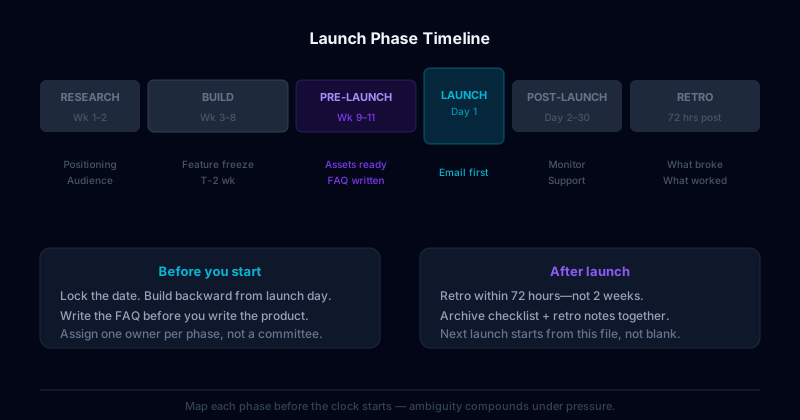
Lock the launch date six weeks out and do not move it without a genuine technical blocker. Social drift (where the date slips because everyone is nervous) costs more than shipping with a few minor rough edges.
Build your announcement assets before you finish the product. Hero images, email subject lines, social announcement copy, and the product page description should all be approved before you write the final line of code. This forces you to describe the thing clearly before you are too close to it.
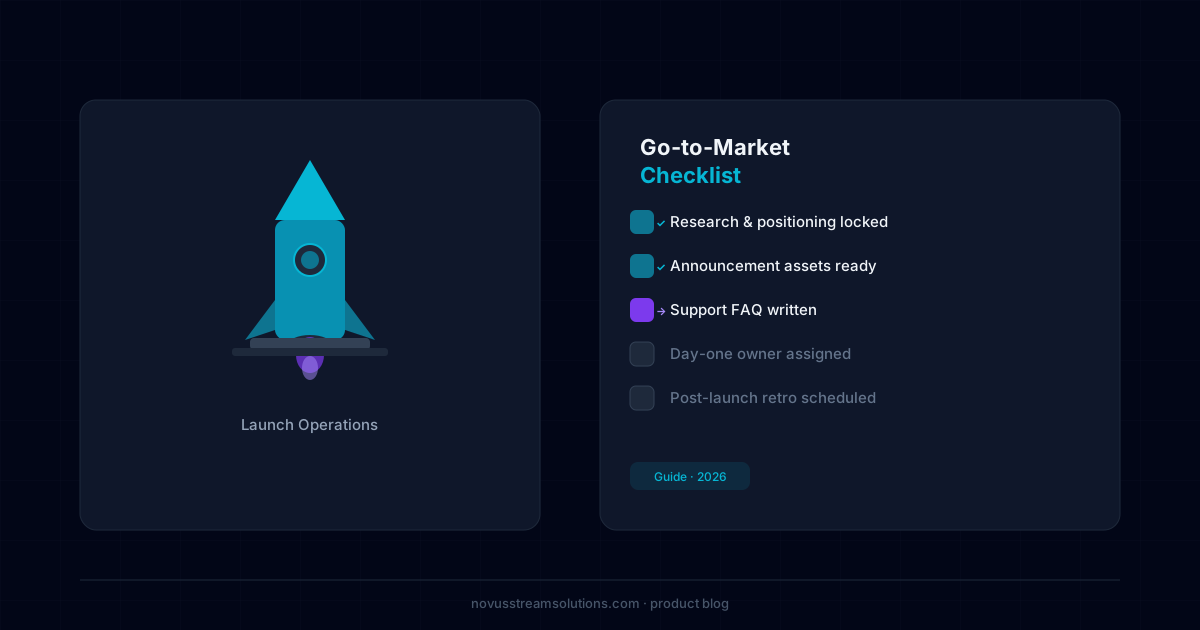
- Designate one owner for launch-day communication. Not a committee.
- Write the support FAQ before launch, not after the first wave of tickets.
- Set a hard cutoff for new features: two weeks before launch, nothing new ships.
Day-one execution
Publish in your owned channels first: email list, product blog, social platforms. Let those audiences feel like insiders before you broadcast to cold audiences. The order signals who you prioritize.
Assign one person to monitor support inboxes and community channels for the first four hours. Unanswered questions in the launch window compound quickly: a single clear reply to one worried question often resolves it for dozens of lurkers.
The post-launch review that makes the next one better
Run a written retrospective within 72 hours while the memory is fresh. Two questions: what broke, and what worked better than expected. Keep it short. The goal is a delta, not a debrief.
Archive the checklist alongside the retro notes. Your next launch starts there, not from a blank template.
Building institutional memory from launch to launch
Most teams treat each launch as a discrete event and start planning the next one from scratch. The compounding advantage goes to teams that carry forward what they learned. This is simpler than it sounds: append three lines to your checklist after each launch: one thing that was missing, one thing that was over-prepared, and one assumption that turned out to be wrong. Over four or five launches, you will have built a lightweight institutional memory that new team members can onboard from without needing to make the same avoidable mistakes.
The teams with the smoothest launches are not the ones with the most elaborate runbooks. They are the ones who run similar launches repeatedly using a checklist that improves incrementally each cycle. The compounding is in the iteration, not in the sophistication of any single document.
Coordinating launch communication across stakeholders
Every person who touches a launch (product, marketing, support, finance) has different information needs and different timing requirements. Product needs to know when marketing will announce so they can have the backend ready. Support needs to know what is launching and what common questions will look like before the first ticket arrives. Finance needs to know when revenue recognition starts. If you coordinate all of this in a single launch Slack channel, messages will be missed and timelines will diverge. A short written communication plan that specifies who gets what information and when is worth the thirty minutes it takes to create.
The communication plan is also the safeguard against the "everyone assumed someone else handled it" failure mode. For each external-facing action (the announcement email, the social post, the product page update, the support documentation) there should be exactly one named owner. Not a team. A person. When that person is unavailable, there should be a named backup. Ambiguity in ownership resolves as inaction at the worst possible moment.
Defining success metrics before launch day
Without pre-defined success metrics, post-launch reviews become revisionist history: everyone gravitates toward the numbers that look best and away from the ones that reveal problems. Deciding in advance what constitutes a successful first week (specific conversion rates, activation milestones, or revenue targets) makes the post-launch review honest rather than political. Write the targets down and share them with the team before launch, not after you see the results.
Choose metrics that reflect actual product-market fit, not surface engagement. Sign-ups are a vanity metric if most of them never activate. Activated users who return in the second week are a much stronger signal. Design your measurement window around the behavior that indicates genuine value delivery, and report that number alongside the headline acquisition numbers to prevent the common mistake of celebrating a spike in sign-ups while missing a low activation rate that predicts early churn.
Run a full dry run before the real thing
The single most effective way to de-risk a launch is to rehearse it end to end before the day arrives. A dry run means actually walking through the entire sequence (publishing the announcement to a test audience, completing a purchase as a customer would, triggering the welcome sequence, opening a support ticket) so that every system is exercised under realistic conditions while there is still time to fix what breaks. The problems a dry run surfaces are almost never the ones you worried about; they are the small, concrete failures like a broken link in the welcome email or a checkout that errors on a particular payment method, which are exactly the failures that erode trust on launch day.
A dry run is also a rehearsal for the people, not just the systems. The person who will monitor support learns where the inbox is and what the common questions look like; the person publishing the announcement confirms they have the access and the copy ready; the owner of each launch action confirms they can actually perform it. Discovering on launch morning that the one person who can publish the announcement is unavailable, or that nobody actually has the password to the email platform, is the kind of avoidable catastrophe a dry run prevents. The cost of a rehearsal is an hour or two; the cost of discovering a broken launch in front of your whole audience is far higher and far harder to undo.
Plan for the launch-day bug, because there will be one
No matter how thorough the preparation, something will go wrong on launch day, and the operations that handle it gracefully are the ones that planned for an unknown failure in advance rather than hoping none would occur. The plan does not need to anticipate the specific bug (it cannot) but it needs to establish the process: who has the authority to decide whether to pause, who can deploy a fix, how a correction gets communicated to people who already encountered the problem, and what the threshold is for rolling back versus pushing forward. Having these decisions made in advance means that when something breaks, the response is calm execution rather than panicked improvisation.
The communication side of a launch-day bug matters as much as the fix. A customer who hits an error and then receives a prompt, honest acknowledgment ("we spotted an issue with X, here is the status, here is what to do in the meantime") often comes away with more trust than one who had a seamless experience, because they saw the operation respond well under pressure. Silence, by contrast, turns a recoverable technical problem into a trust problem. The discipline is to treat the inevitable launch-day issue not as a failure of preparation but as a scenario you prepared for, with a response that demonstrates competence rather than concealing a stumble. Launches are judged less by whether anything went wrong than by how the team handled what did.
Sequence the announcement, do not blast it
A launch announcement is not a single event but a sequence, and getting the order right is part of the operations. The principle is concentric circles of audience warmth: the people closest to you (your email list, your most engaged community members, early supporters) hear first and feel like insiders, then the announcement radiates outward to broader social audiences and finally to cold channels. This ordering is not just courtesy; it is strategic, because a launch that has early traction and early social proof from your warm audience performs better when it reaches colder audiences who look for signals that others have already engaged.
Sequencing also lets you adjust as you go rather than committing everything at once. If the warm-audience launch surfaces a problem (a confusing message, an unexpected objection, a technical issue) you can fix it before the announcement reaches the larger, less forgiving cold audience. A simultaneous blast to every channel forfeits that ability, exposing your widest audience to the same unrefined launch your closest audience saw. Staging the announcement turns the early, friendlier audience into both a privilege you extend to them and a final layer of testing before the launch hits the people least likely to give you a second chance. The order signals who you prioritize and protects the launch at the same time.
Capturing momentum after the launch spike
Most launches generate a spike of attention that then decays, and a common operations failure is having no plan for what happens after the spike. The attention a launch generates is a perishable asset: the people who showed up, signed up, or bought are at their highest engagement in the first days, and an operation that does not have a plan to convert that engagement into a durable relationship loses most of it. The post-launch plan should specify how new users are onboarded, how their first experience is made successful, and how the momentary spike of interest is converted into the second visit, the second purchase, or the active-user behavior that actually sustains the product.
This is where the distinction between a launch and a sustainable product becomes operational. A launch that spikes and decays to nothing has acquired attention without building anything; a launch that spikes and then retains a meaningful fraction of the attention has converted a moment into momentum. The work of capturing the spike (a strong onboarding, a reason to return, a clear next step) is less glamorous than the launch itself but determines whether the launch mattered. Planning the post-spike capture before launch, rather than scrambling once the attention is already fading, is what separates a launch that builds a base from one that was just a good day. The spike is the opportunity; the capture is the result.
Run a pre-mortem before you commit
A pre-mortem is the launch-planning exercise of imagining, before anything has happened, that the launch has already failed, and then working backwards to ask what caused the failure. The technique is powerful because it gives people permission to voice concerns that optimism normally suppresses: in the framing where failure is assumed, raising a potential problem is constructive rather than pessimistic. A small team that spends thirty minutes asking "it is two weeks after launch and this went badly; why?" will surface the realistic risks (the underprepared support, the untested payment path, the message that does not land) while there is still time to address them.
The pre-mortem complements the dry run: the dry run finds the concrete things that are broken, while the pre-mortem finds the strategic and operational risks that are not yet visible because they have not been built. Together they cover both the "does this work" and "what could go wrong" questions that a launch needs answered in advance. The output of a pre-mortem is a short list of the most plausible failure modes and a decision for each (mitigate it, accept it, or build a contingency for it) which turns vague launch anxiety into a concrete set of handled risks. The exercise is cheap, takes one short meeting, and routinely prevents the specific failure that would otherwise have been obvious only in hindsight.
Protecting the support surface during the spike
Launches generate a concentrated burst of questions, and the support surface is where a launch most visibly succeeds or fails in the moment, so it deserves deliberate operational attention. The single most effective preparation is to write the support documentation before launch rather than after the first wave of tickets, anticipating the common questions from the dry run and the product itself, so that the answers exist before they are needed. A well-prepared support surface turns what would be a flood of individual responses into a manageable flow where most questions are already answered and only the genuine edge cases require live attention.
During the launch window itself, having one person dedicated to monitoring support and community channels for the first hours pays off disproportionately, because an unanswered worried question in a public channel is read by many silent observers, and a single clear answer resolves the doubt for all of them. The launch window is exactly when responsiveness matters most and when the team is most distracted by everything else happening, which is why the responsibility has to be assigned to a specific person rather than left to whoever notices. Protecting the support surface during the spike is protecting the first impression of every new user who needed help, and the first impression of a new user who got a fast, clear answer is one of the most valuable outcomes a launch can produce.
Why launches are operations, not events
The throughline of all of this is that a launch is an operation rather than an event, and treating it as the former is the core discipline. An event is a moment you prepare for and then experience; an operation is a system you design, rehearse, execute, and review. The reframe matters because it changes where the attention goes: an event mindset pours energy into the launch moment and treats everything around it as secondary, while an operations mindset recognizes that the launch moment is the smallest part, surrounded by the much larger work of preparation, contingency planning, sequencing, and post-launch capture that actually determines the outcome.
This is also why launches improve with repetition for teams that treat them operationally. An event is hard to learn from because it is singular; an operation is a repeatable process whose components can each be refined cycle over cycle. The team that runs its fifth launch with an improved checklist, a rehearsed sequence, a tested contingency plan, and a proven post-spike capture is not more talented than the team running its first; it is running a more mature operation. The compounding advantage of treating launches as operations is that each one makes the next one smoother, which is exactly the institutional memory a small team needs to make launching a reliable capability rather than a recurring scramble. The product is the what; the operation is the how, and the how is what you can actually get better at.
Frequently asked questions
Quick answers to common questions about this topic.
What goes on a small-team product launch checklist?
Pre-launch: assets, pages, and messaging ready; launch day: publish, announce across your channels, and monitor; after: follow up, gather feedback, and fix what broke. A realistic checklist beats an elaborate plan nobody follows.
What do small teams get wrong about launches?
Treating launch as a single moment instead of a sequence. The pre-work and the follow-through matter as much as the day itself, and a checklist keeps the unglamorous parts from being skipped.
Related troubleshooting
Was this page helpful?
Your answer stays in this browser, it is not sent anywhere and no account or cookie is involved.