2026 · Field notesAbout 13 min readNovus Stream Solutions
Multi-platform operations: the hub-and-spoke model for small teams
How small teams maintain a consistent presence across email, community platforms, social, and storefronts without constant context-switching: the hub-and-spoke content distribution model.
Contents
- 1.Overview
- 2.Hub discipline: what goes to the hub first
- 3.The annual platform audit
- 4.Managing the spoke relationship without losing the hub
- 5.When to add a new spoke and when to resist
- 6.Cross-platform consistency in voice and terminology
- 7.Measuring spoke-to-hub conversion to validate the model
- 8.Decision fatigue is the real cost of many platforms
- 9.Owned versus rented determines where to invest
- 10.One source of truth, many derivations
- 11.Being absent beats being inconsistent
- 12.Repurposing as a system, not an afterthought
- 13.The hub must hold your best work
- 14.How we run hub-and-spoke as one codebase
Overview
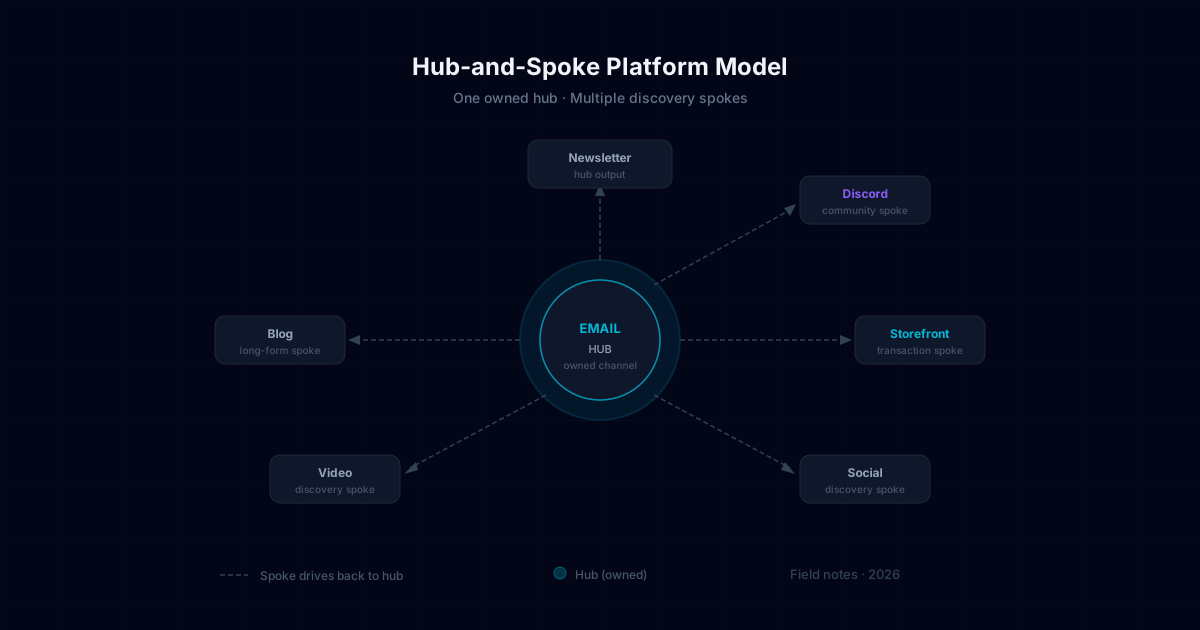
The problem with multi-platform presence is not effort; it is decision fatigue. When you treat every platform as a primary publishing surface, you spend more time deciding what to post than actually creating. The hub-and-spoke model solves this by designating one channel as the source of truth and every other channel as a distribution layer.
For most small teams, the hub is email. Email is owned, algorithm-free, and the only platform where your audience has explicitly asked to hear from you. Everything else is a spoke, a place where you drive discovery back to the hub.
Hub discipline: what goes to the hub first
Anything you want your best audience to see should go to email first, before it goes anywhere else. Long-form thinking, product announcements, and early access offers belong in the hub. Spokes carry the headlines, not the full story.
This creates a clear value proposition for email subscribers: they get more and they get it first. That proposition is what justifies asking someone for their email address in an era when most people guard it carefully.
- Email: hub. Deep content, first access, direct relationship.
- Community platform: real-time spoke. Discussion and quick updates.
- Storefront: transaction spoke. Links from all other channels.
- Social and video: discovery spokes. Teasers that drive to email.
The annual platform audit
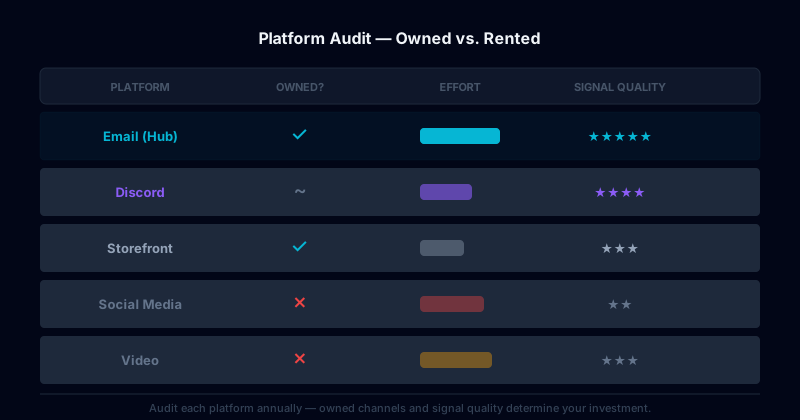
Once a year, review each platform you are active on and ask three questions: Is this channel owned or rented? How much effort does it require relative to the audience size it reaches? Does it drive people toward my hub or away from it?
Platforms that score low on all three get either deprioritized or cut. Being consistently absent from a channel is better than being inconsistently present; inconsistency signals instability to new visitors who are deciding whether to follow.
Managing the spoke relationship without losing the hub
The most common failure mode in hub-and-spoke content distribution is inversion: the spokes gradually become the primary creative output, and the hub becomes a summary of what already appeared elsewhere. This happens because spoke content is lower stakes: a short social post or a quick community update takes minutes, while a thorough email issue takes hours. The path of least resistance over time leads to more spoke content and less hub content, which is exactly backwards.
Protect the hub by treating it as a non-negotiable calendar commitment. Spoke content can flex; hub content should not. If you need to reduce output somewhere, reduce the frequency or depth of spoke content rather than skipping hub issues. Your best audience members are hub subscribers: they have given you something more valuable than a follow or a join, which is an inbox relationship. Honor that by making the hub your best work, not your leftover work.
When to add a new spoke and when to resist
Every new platform request or opportunity should be evaluated against the same question: does adding this spoke strengthen the hub, or does it fragment my attention in a way that weakens it? A new video platform that drives meaningful email subscriptions is worth the production cost. A new community platform that requires daily moderation without a clear path to hub growth is probably not.
The test is not whether a platform is popular or growing; it is whether your specific audience is there in meaningful numbers and whether the platform structure supports the hub-and-spoke flow. Some platforms are architecturally hostile to this model: they reward content that stays on-platform and penalize links out. Investing in those platforms requires either accepting that they will not feed your hub or finding creative ways to create enough value there that people seek out your hub independently.
Cross-platform consistency in voice and terminology
When the same brand appears across five platforms and each one sounds slightly different (different level of formality, different product names, different ways of describing what you do) the cumulative effect is a brand that feels uncertain of itself. Audiences who encounter you on multiple platforms pick up this inconsistency even if they cannot articulate it. The fix is not identical copy across channels, which would feel robotic, but a shared voice guide that defines the non-negotiables: how formal or informal you are, which product terms are canonical, what topics you never discuss, and what tone you use when acknowledging problems.
Voice consistency is especially important at the edges: error messages, support responses, and the language you use when something goes wrong. These moments are high-stakes for trust, and they are often the places where voice guidance is least applied. A brand that sounds warm and authentic in its newsletter but cold and bureaucratic in its support responses creates cognitive dissonance that erodes the brand equity the newsletter built.
Measuring spoke-to-hub conversion to validate the model
The hub-and-spoke model is only working if spokes are actually driving traffic and subscriptions to the hub. Track this directly: use UTM parameters or platform-specific tracking on links from each spoke to the hub, and review the conversion path monthly. If your social spoke generates 3,000 impressions per post but drives 12 email subscriptions per month, the math may not justify the production time. If your community spoke generates 400 members and 80 email subscriptions per month, it is converting at a rate that earns continued investment.
Do not assume the model is working because the theory is sound. Audiences behave differently than models predict, and the spoke that seems most obvious to invest in may be converting at a fraction of the rate of a smaller, less prominent one. The data tells you which spokes are earning their investment and which are consuming creative energy without feeding the hub. Make investment decisions based on the measured conversion rate, not on platform size or personal enthusiasm for the format.
Decision fatigue is the real cost of many platforms
The reason multi-platform presence is exhausting is not primarily the effort of creating content but the decision fatigue of treating every platform as a primary surface that needs its own original thinking. When each platform is a place you must decide what to post, you multiply the number of creative decisions by the number of platforms, and the cumulative weight of those decisions is what burns out small teams more than the production itself. The hub-and-spoke model attacks this directly by collapsing the decision to one: you decide what goes on the hub, and the spokes carry derivations of that single decision rather than each demanding its own.
This reframing of the cost is what makes the model valuable beyond mere efficiency. A team that has to invent something for email, something different for each social platform, and something else for the community is making many independent creative decisions, each of which has a cost in attention and willpower; a team that creates once for the hub and adapts that for the spokes makes one creative decision and several mechanical adaptations. The mechanical adaptations are cheap; the creative decisions are expensive, and the model concentrates the expensive part in one place. Recognizing that the binding constraint on multi-platform presence is decision fatigue rather than production effort is what reveals why a single-source model is so much more sustainable than treating every channel as primary.
Owned versus rented determines where to invest
A foundational distinction for allocating effort across platforms is between channels you own and channels you rent. An owned channel (your email list, your website) is one where you have a direct relationship with the audience that no third party can disrupt; a rented channel (any social platform) is one where an algorithm and a platform owner sit between you and your audience and can change the terms, the reach, or the rules at any time. The strategic implication is that owned channels deserve the central position, because the relationship there is durable, while rented channels are useful for discovery but risky to depend on, because the landlord can change the lease.
This is why the hub should be an owned channel and the spokes can be rented ones. You build your durable relationship on the channel you control, and you use the rented channels to drive discovery back toward it, so that even if a rented platform's algorithm turns against you or the platform declines, the audience relationship you actually depend on is safe on the owned channel. The mistake many operations make is building their primary relationship on rented land (investing everything in a social following that the platform can devalue overnight) rather than using the rented channels to feed an owned one. The owned-versus-rented distinction is the lens that determines where to put your durable investment and where to accept the impermanence of borrowed reach.
One source of truth, many derivations
The mechanical core of the hub-and-spoke model is that content is created once for the hub and then derived into platform-appropriate forms for the spokes, rather than being independently created for each platform. A long-form hub piece becomes the source from which a series of social posts, a community discussion prompt, and a short teaser are derived, each adapted to its platform but all tracing back to the single original. This derivation approach is what makes broad presence affordable: the expensive creative work happens once, and the spokes are adaptations rather than new creations, so the marginal cost of another platform is the adaptation rather than another full piece.
The discipline that makes derivation work is resisting the inversion where the spokes become the primary creative output and the hub becomes a summary of what already appeared elsewhere. Derivation flows from hub to spoke, not the reverse: the hub holds the full, original thinking, and the spokes carry pieces of it outward. When this flows backward (when the quick spoke content becomes where the real thinking happens and the hub becomes a digest) the model has inverted and lost its value, because the owned channel that should hold your best work has become an afterthought. Keeping the derivation directional, with the hub as the source and the spokes as the outputs, is what preserves both the efficiency of creating once and the primacy of the owned channel where your best audience lives.
Being absent beats being inconsistent
A counterintuitive but important principle for multi-platform presence is that being consistently absent from a channel is better than being inconsistently present on it. A new visitor who finds a channel you abandoned months ago (a profile with a burst of activity and then silence) reads that inconsistency as a signal of instability, an operation that started something and could not sustain it. A visitor who finds you simply not present on a channel reads nothing negative; absence is neutral, while abandoned presence is a visible failure to maintain. This means the decision to be on a platform is a decision to be on it reliably, and if you cannot sustain a channel, not being there is the better option.
This principle should govern which platforms you take on. Rather than establishing a presence everywhere and maintaining most of them poorly, it is better to be reliably present on the few channels you can actually sustain and simply absent from the rest. The annual platform audit is the mechanism for enforcing this: a channel you cannot maintain consistently should be cut rather than left to decay into the instability signal that abandoned presence sends. Spreading thin across many channels, present on all but reliable on none, is worse than concentrating on a sustainable few, because the inconsistency actively damages the impression you make on new visitors. Choosing where to be present is also choosing where to be absent, and deliberate absence is a stronger position than inconsistent presence.
Repurposing as a system, not an afterthought
For the hub-and-spoke model to be sustainable, repurposing hub content into spoke content has to be a system rather than an improvised afterthought, because ad hoc repurposing reintroduces exactly the decision fatigue the model is meant to eliminate. A repurposing system specifies, for each spoke, what kind of derivation it receives from a hub piece (the social platform gets these formats, the community gets this kind of prompt, the teaser follows this pattern) so that turning a hub piece into spoke content is a known process rather than a fresh creative decision each time. The system converts repurposing from a series of small inventions into a repeatable workflow.
The payoff of systematizing repurposing is that it makes broad, consistent presence achievable for a small team without the burnout that improvised repurposing causes. When the derivations are systematic, a single hub piece reliably produces its full set of spoke content through a known process, so the team can maintain presence across many channels from one creative effort. Without the system, each repurposing is a decision, and the accumulated decisions are the fatigue that makes multi-platform presence unsustainable. Building the repurposing into a defined workflow (this hub piece yields these specific spoke derivations through these specific steps) is what lets the model deliver its promise of broad presence from concentrated effort, rather than quietly recreating the per-platform decision burden it was supposed to remove.
The hub must hold your best work
The single most important rule for keeping the hub-and-spoke model healthy is that the hub must consistently hold your best work, because the hub is the channel where your most committed audience lives and the value proposition that justifies asking for their attention. The people on your owned channel have given you more than a follow (they have given you a direct line, which is increasingly rare and guarded) and the only thing that justifies that exchange over time is that they receive your best, first. A hub that becomes a digest of what already appeared on the spokes inverts this, offering the most committed audience the least, which erodes the very relationship the model exists to build.
Protecting the hub as your best work requires treating it as a non-negotiable priority rather than the place leftover energy goes after the spokes are fed. The natural drift is toward the spokes, because spoke content is quick and immediately gratifying, while hub content is more demanding; left unchecked, that drift starves the hub of the quality it needs. The discipline is to make the hub the first claim on your creative effort and the spokes the derivations, so that the best audience reliably gets the best work. The hub is where trust is deepest and where the commercial and growth value of the audience is greatest, and honoring that by making it your best work (not your leftover work) is what keeps the whole model worth running. Everything else is discovery; the hub is the relationship.
How we run hub-and-spoke as one codebase
For Novus, hub-and-spoke is not only a content-distribution metaphor; it is the literal software architecture. The hub, novusstreamsolutions.com, is a single Next.js App Router project that serves every narrative and reference surface: the portfolio, ventures, Documentation, Product blog, and Changelog all render from one codebase using a components/sections pattern, with no separate app per page. The product spokes (the background remover and Novus Visualizers) live on their own subdomains as independent applications, linked to and from the hub. That split keeps the maintenance burden sane for a very small team: the hub is the one place to explain the ecosystem, and the spokes are where the actual work happens, so neither has to carry the other's complexity.
The benefit of running the hub as a single project shows up in consistency and speed. One layout, one design system, one sitemap generator, and one set of metadata rules apply across every hub page automatically, so a new section inherits correct navigation, share images, and structured data without bespoke wiring. Deploys ride Vercel previews, which means a change to any spoke-facing page can be reviewed and promoted (or rolled back) in minutes without an ops process. The discipline that makes the spoke metaphor work for content is the same discipline that makes it work in code: each property has one clear job, and the hub's only job is to route attention to the right spoke and explain how the pieces fit together.
Frequently asked questions
Quick answers to common questions about this topic.
What is the hub-and-spoke model for content?
A central hub you own (your site and email list) is home base, and social platforms are spokes that distribute and drive people back to it. You build on owned ground and use rented reach to feed it.
Why not just build an audience on social platforms?
Because platform reach is rented and can change overnight. The hub-and-spoke model uses platforms for discovery but keeps the durable relationship on channels you control.
Related troubleshooting
Was this page helpful?
Your answer stays in this browser, it is not sent anywhere and no account or cookie is involved.