2026 · Novus SupplyAbout 12 min readNovus Stream Solutions
Conversion quality over raw traffic in a small storefront
It is tempting to chase more visitors. For a small storefront, the higher-leverage work is usually making the visitors you already have convert — through image quality, clear listings, and honest expectations. A note from the commerce side of the ecosystem.
Overview
The default growth instinct for a storefront is "get more traffic." It feels like progress — more visitors, bigger numbers, more chances to sell. But for a small operation, raw traffic is often the more expensive and less reliable lever, and the higher-leverage work is usually quieter: making the visitors you already have more likely to buy. This is a note from the commerce side of the ecosystem on why conversion quality tends to beat traffic volume, and the unglamorous things that actually move it.
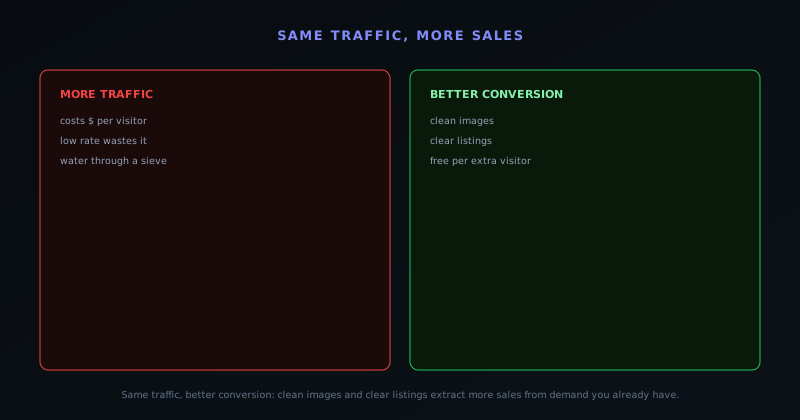
The arithmetic is plain. Doubling traffic and doubling conversion both double sales, but doubling conversion costs nothing per additional visitor — you are extracting more from demand you have already paid to attract — while doubling traffic usually means spending more to acquire each new visitor. For a lean operation, improving the rate is frequently the cheaper path to the same outcome.
Why traffic is the seductive wrong default
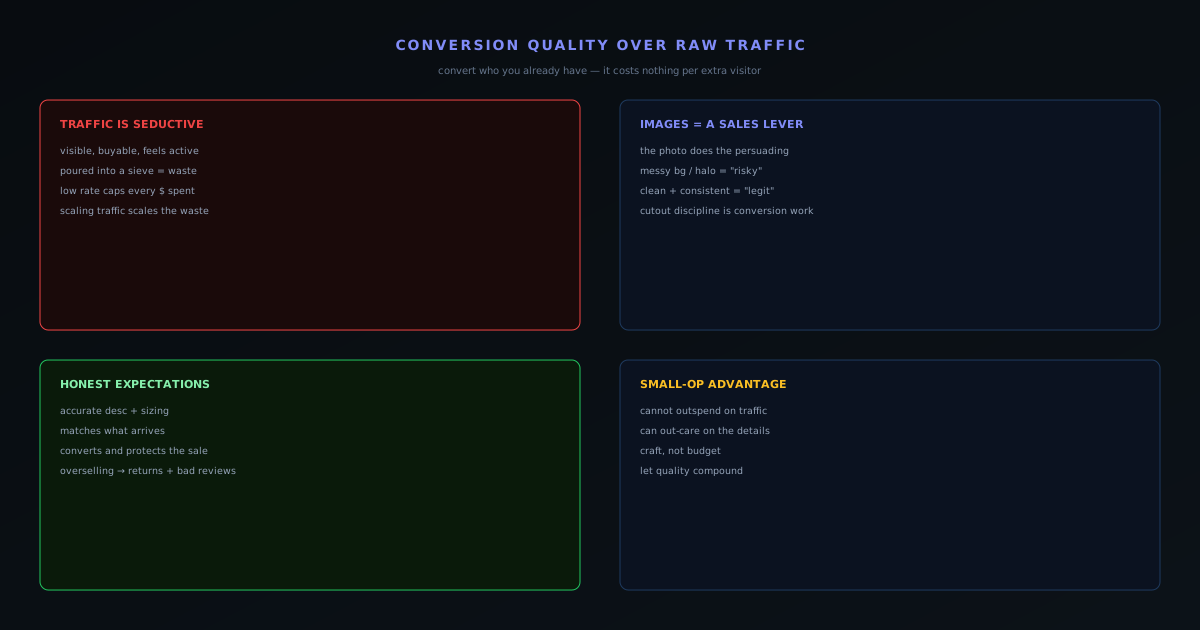
Traffic is seductive because it is visible and feels active. You can buy it, you can watch the visitor count climb, and rising numbers feel like momentum. But traffic poured into a storefront that does not convert is water through a sieve — you pay for the visitors, they arrive, they leave, and you are left with a bigger bill and the same sales. Worse, a low conversion rate caps the return on every acquisition dollar, so scaling traffic before fixing conversion scales the waste.
Conversion work is less visible and less immediately satisfying, which is exactly why it is underdone and therefore where the opportunity sits. The storefront that converts well turns the same traffic into more sales, and makes every future acquisition effort pay off harder. Fix the rate first, then traffic becomes worth buying.
Image quality is a conversion lever, not a vanity one
Online, a shopper cannot touch the product, so the imagery does almost all the persuading. Clean, consistent, professional product images are not a cosmetic nicety — they are a primary driver of whether someone trusts the listing enough to buy. A product shot with a messy background, inconsistent framing, or a visible halo from a bad cutout reads as amateurish, and amateurish reads as risky. The same product on a clean, consistent background reads as legitimate.
This is where the commerce side and the tools side of the ecosystem meet. The discipline of producing clean cutouts and consistent, marketplace-ready image packs is, viewed through a commerce lens, conversion-rate work. Better images are not about looking nice; they are about removing the visual doubt that stops a hesitant shopper from clicking buy.
Honest expectations convert and protect
A subtler conversion lever is honesty in the listing. Accurate descriptions, clear sizing and delivery expectations, and imagery that matches what arrives all build the kind of trust that converts a hesitant browser — and just as importantly, they protect the sale after it happens. Overselling can win a click and lose it back to a return, a bad review, and a customer who will not return. The honest listing converts a little less aggressively up front and far better over the lifetime of the relationship.
For a small storefront, where reputation and repeat business carry disproportionate weight, this matters even more than for a large one. A single honest, well-presented listing that converts cleanly and produces a happy customer is worth more than a flashy one that drives returns. Conversion quality includes the quality of what happens after the purchase.
The arithmetic that favors conversion
The case for prioritizing conversion over traffic is, at bottom, arithmetic, and seeing it laid out makes the priority hard to argue with. Sales are traffic multiplied by conversion rate, so doubling either doubles sales — but the two are not equally cheap to double. Doubling traffic generally means spending more to acquire each additional visitor, a cost that recurs for every new person you bring in. Doubling conversion costs nothing per additional visitor; it extracts more value from the demand you have already paid to attract. For an operation watching every dollar, improving the rate is frequently the cheaper route to the same increase in sales.
The asymmetry compounds when you consider what each improvement does to the other. A higher conversion rate makes every future traffic effort more efficient, because each visitor you later acquire is now more likely to buy — so conversion work pays off not once but on all subsequent traffic. Traffic spending, by contrast, does nothing to improve conversion; it just pushes more people through whatever rate you currently have. This is why the sequencing matters: fix conversion first, and then traffic becomes worth buying, because you are pouring acquired visitors into a funnel that actually converts rather than one that leaks them. Doing it in the other order scales the waste.
Where conversion actually leaks
Improving conversion is more tractable when you think about where a sale is actually lost, because the leaks are specific rather than mysterious. A visitor who lands on a listing forms a fast, largely visual judgment about whether the product and the seller look legitimate; if the imagery is poor, the framing inconsistent, or the page slow, many leave before reading a word. Those who stay then weigh whether the listing answers their questions — sizing, materials, what they will actually receive — and ambiguity at that stage costs the sale. Each of these is a concrete point where a hesitant buyer drops out, and each is addressable.
Naming the leaks turns conversion from a vague aspiration into a checklist of fixable problems. The visual first impression is fixed with clean, consistent imagery; the question-answering stage is fixed with accurate, complete descriptions and honest expectations; the friction of a slow page is fixed with optimized images and a clean layout. None of these require more traffic or more spend — they require attention to the specific moments where visitors currently leave. For a small seller, that is empowering, because it means conversion is not a black box but a sequence of identifiable points to improve, most of which come down to presentation and honesty rather than budget.
Online, the photo does the touching
The reason image quality is a conversion lever rather than a cosmetic nicety comes down to a basic fact of selling online: the buyer cannot touch, hold, or inspect the product, so the imagery has to do all the sensory work that physical handling would do in a store. A clean, well-presented photo is the closest a shopper gets to examining the item, and it carries almost the entire burden of convincing them the product is real, well-made, and as described. When the imagery fails — a messy background, a visible halo from a bad cutout, inconsistent lighting — the shopper's only window onto the product is smudged, and doubt fills the gap.
This is where the tools side and the commerce side of the ecosystem meet directly. The discipline of producing clean, true straight-alpha cutouts and consistent, marketplace-ready imagery is, viewed through a commerce lens, conversion-rate work — it is removing the visual doubt that stops a hesitant shopper from clicking buy. Better images are not about aesthetics for their own sake; they are about giving the buyer enough confidence, through the one channel available, to commit. For an online seller, investing in image quality is investing in the primary instrument of persuasion they have, which is why it sits at the center of conversion rather than at the margins.
Consistency reads as legitimacy
Beyond the quality of any single image, the consistency across a storefront is itself a powerful conversion signal, because consistency reads as legitimacy. A shopper browsing a store where every product is presented the same way — same kind of clean background, same framing, same edge quality — perceives an operation that has its act together, and that perception lowers the perceived risk of buying. Inconsistency does the opposite: a product that looks one way here and another there, or whose images vary in quality from listing to listing, plants a small seed of doubt about whether the seller is reliable, and doubt suppresses conversion.
This is an area where a small seller can genuinely compete with much larger ones, because consistency is a matter of discipline rather than budget. Running every product through the same tool with the same settings produces a uniform set of images at no extra cost beyond the discipline of doing it, and that uniformity makes a small catalog look as considered as a big brand's. The batch-processing and image-pack workflows exist partly to make this consistency easy to achieve at scale, so that even a one-person operation can present a coherent, legitimate-feeling storefront. Consistency is conversion work that costs attention, not money, which is exactly the kind of lever a small operation should pull hard.
Speed and image weight are conversion factors
A less obvious conversion leak is page speed, and it is tied directly to how images are handled — a storefront heavy with oversized image files loads slowly, and slow loads lose impatient visitors before they ever see the product. This is where the format decisions that seem like technical minutiae become commercial decisions: serving optimized formats like WebP or AVIF on your own storefront, where you control the rendering, can cut image weight substantially compared to PNG, which means faster pages, which means fewer visitors lost to a spinner. Image quality and image weight are both conversion factors, pulling in tension, and balancing them is real conversion work.
The practical approach is to match format to context: maximum-compatibility formats where a marketplace requires them, lighter optimized formats where you control the storefront and page speed is in your hands. The smart-format tooling that recommends a format per image is, in this light, a conversion aid — it helps ensure your own storefront stays fast without sacrificing the quality that persuades. A seller who ignores image weight can have beautiful photos on a storefront so slow that visitors leave before seeing them, which is the worst of both worlds. Attending to both the look and the load is how images serve conversion fully rather than undermining it through sheer file size.
The sale continues after checkout
Conversion is usually framed as getting the click, but for a small operation the sale really continues after checkout, and honest expectations are what protect it there. A listing that oversells — imagery or descriptions that promise more than arrives — can win the initial purchase and lose it right back to a return, a refund, and a disappointed customer who will not come back. Accurate descriptions, realistic imagery, and clear delivery expectations convert a little less aggressively up front but far better over the lifetime of the relationship, because they produce satisfied customers rather than buyer's remorse.
For a small seller, where reputation and repeat business carry disproportionate weight, this longer view of conversion matters even more than for a large one. A single honest, well-presented listing that converts cleanly and produces a happy customer is worth more than a flashy, exaggerated one that drives returns and bad reviews, because the happy customer comes back and the burned one warns others. Conversion quality, properly understood, includes the quality of what happens after the purchase — whether the product matches the promise, whether the experience earns a repeat. Optimizing only for the click, at the expense of the post-purchase reality, is a false economy that a reputation-dependent small operation can least afford.
Measuring conversion when the numbers are small
A caution comes with all this: at the small scale where conversion work matters most, the conversion rate is also at its noisiest, and reading it badly can mislead the very decisions it should inform. With few visitors and few sales, a single extra purchase can swing the apparent rate dramatically, so a good day or a bad day tells you almost nothing on its own. The honest way to track conversion at small scale is to watch the trend over enough time to wash out the noise, not to react to individual days, and to treat any single data point as mostly chance rather than signal.
This connects conversion work to honest measurement, because improving a rate you cannot reliably read is a recipe for chasing noise. The discipline is to make deliberate improvements — better images, clearer listings, honest expectations — and then evaluate them over a long enough window that the underlying change separates from the daily randomness. Expecting a clean before-and-after from a tiny sample will only produce false conclusions in both directions. Conversion is the right thing to optimize for a small storefront, but optimizing it well requires the patience to measure it honestly, which is its own skill and one worth pairing with the conversion work itself.
A practical loop for improving the rate
Conversion work is most effective as a deliberate loop rather than a one-time overhaul, and the loop is simple to run even solo. Pick one concrete leak — say, inconsistent product imagery across listings — make a focused improvement to it, and then observe the effect over a window long enough to see past daily noise before moving to the next. Working one change at a time is what lets you attribute a shift to a specific improvement rather than guessing among several simultaneous changes, and it keeps the work manageable for an operation where the same person handles everything. Small, sequential, measured improvements compound into a meaningfully better funnel over time.
The discipline that makes the loop honest is resisting the urge to judge a change on a day or two of data. At small scale the rate is noisy, so a change that looks like a triumph on Tuesday and a disaster on Wednesday may be neither — it is the sample size talking. Giving each improvement a fair evaluation window, and trusting the trend rather than the spike, is what separates real conversion progress from chasing randomness. Run the loop patiently — improve a leak, measure over time, keep what genuinely helps, move on — and a small storefront's conversion rate climbs steadily on the back of accumulated, verified improvements rather than on a single dramatic redesign.
The small-operation advantage
Focusing on conversion plays directly to a small operation's strengths. You cannot outspend large competitors on traffic acquisition, but you can absolutely out-care them on the details — cleaner images, clearer listings, more honest expectations, a storefront that respects the visitor. Those are craft, not budget, and craft is where a small, attentive seller can genuinely win. The big players are optimizing for scale; the small one can optimize for the experience of each visitor.
So the operating posture on the commerce side mirrors the one on the software side: do the unglamorous quality work well, and let it compound. The image-pack post covers the production discipline that feeds conversion, the omni-channel post covers running the operations behind it, and the boundaries post covers keeping the retail and software sides of the ecosystem cleanly separated so each can be judged on its own terms.